

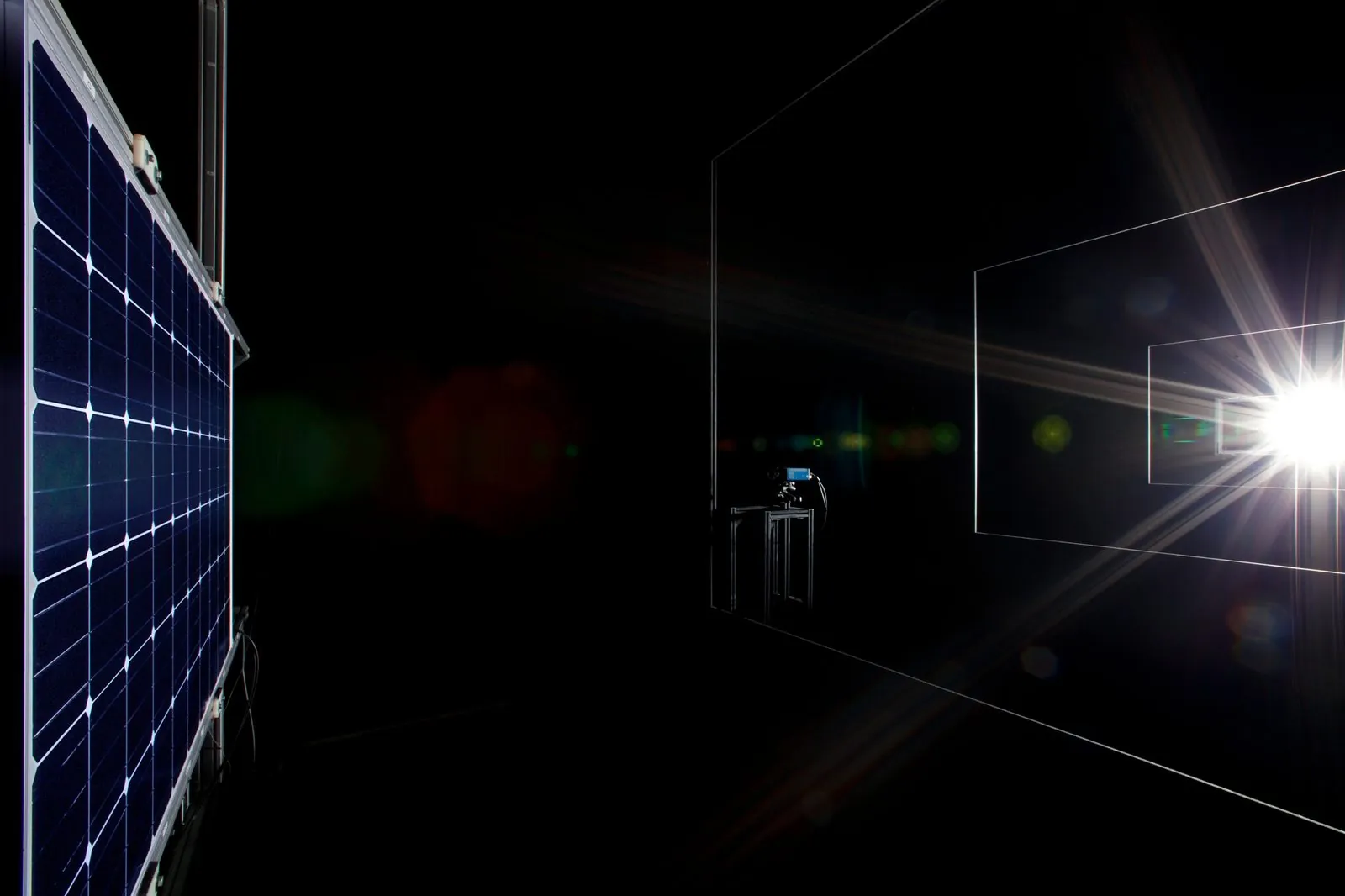


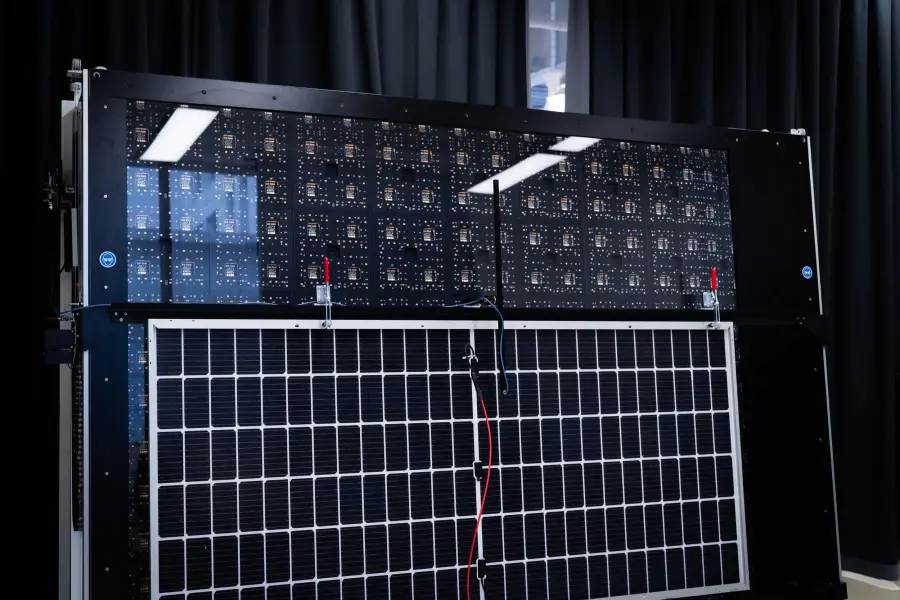
 Electroluminescence Imaging
PV metrology terms, defined precisely
Many disputes over a module's power are disputes over words. These definitions follow the International Vocabulary of Metrology (VIM), the GUM and the IEC 60904 series, with the confusions that cause the most trouble spelled out.
- A++ (Pasan convention)
- Accreditation (ISO/IEC 17025)
- Accuracy, trueness and precision
- Bifaciality and equivalent irradiance
- Calibration
- Calibration uncertainty
- Capacitive effects and I-V hysteresis
- Intercomparison and proficiency testing
- Intermediate precision
- Linearity
- Measurement uncertainty
- Metastability
- Metrological traceability
- Preconditioning and stabilisation
- Primary, secondary and working reference devices
- Repeatability
- Reproducibility
- Spatial non-uniformity of irradiance
- Spectral coverage (SPC) and spectral deviation (SPD)
- Spectral match (classification)
- Spectral mismatch factor
- Standard test conditions (STC)
- Standard uncertainty, combined and expanded uncertainty
- Temporal instability (STI and LTI)
- Type A and Type B evaluation
- A++ (Pasan convention)
- Not an IEC class. IEC 60904-9 edition 3 defines A+, A, B and C. Pasan uses A++ for a simulator that stays within half of the A+ limit on a characteristic, for example spectral match 0.9375 to 1.0625, non-uniformity 0.5 % and long-term instability 0.5 %, so that the figure can be checked against a classification report.
- Accreditation (ISO/IEC 17025)
- Formal recognition by an accreditation body that a laboratory is competent to carry out specified tests or calibrations, within a published scope. It covers the laboratory's procedures, staff, equipment calibration, traceability, uncertainty evaluation and participation in proficiency tests.Not to be confused with: A property of an instrument. No simulator is accredited; a laboratory is, and the simulator is one of the instruments whose calibration and traceability it has to demonstrate.
- Accuracy, trueness and precision
- Accuracy is the closeness of a result to the true value; it is a qualitative concept, quantified by the measurement uncertainty. Trueness is the closeness of the average of many results to a reference value; precision is the closeness of results to each other.
- Bifaciality and equivalent irradiance
- Bifaciality is the ratio of the rear-side to the front-side short-circuit current (or maximum power) measured at the same irradiance. Equivalent irradiance is the front irradiance that, under single-sided illumination, produces the same current as a given combination of front and rear irradiance.
- Calibration
- An operation that establishes the relation between the values given by a measurement standard, with their uncertainties, and the corresponding indications of an instrument, and uses it to obtain a measurement result from an indication. Calibrating a reference cell assigns it a short-circuit current per unit irradiance under the reference spectrum, with an uncertainty.Not to be confused with: Adjustment. Setting a simulator's irradiance to a reference cell reading is an adjustment that relies on a calibration done elsewhere.
- Calibration uncertainty
- The uncertainty stated on a calibration certificate for the calibrated value, for example the short-circuit current calibration of a reference cell or module. It is an input to every measurement made with that reference and is usually the largest single term of a module power budget.Not to be confused with: The uncertainty of the measurements made afterwards. Those add spectral mismatch, uniformity, temperature, instability and device effects on top of it.
- Capacitive effects and I-V hysteresis
- High-efficiency cells store charge in their junction and passivation layers. If the voltage sweeps faster than the device can follow, the forward and reverse I-V curves differ and the measured maximum power is wrong. Longer sweeps, multi-step or multi-flash methods and dedicated hysteresis-free methods remove the artefact.
- Intercomparison and proficiency testing
- An intercomparison (round robin) circulates the same devices among laboratories and compares their results; proficiency testing uses intercomparisons to evaluate laboratories against criteria, typically the normalised error En, which compares the difference between two results with their combined expanded uncertainty.
- Intermediate precision
- Precision under conditions that keep the procedure and location but let other factors vary over an extended period: different days, operators, recalibrations. It is the honest measure of how stable a laboratory's own results are, for example on a control module measured every week.
- Linearity
- The degree to which a device's short-circuit current is proportional to irradiance. A reference device must be linear over the range it is used in, and translation of I-V curves between irradiance levels assumes it.
- Measurement uncertainty
- A non-negative parameter that characterises the dispersion of the values that could reasonably be attributed to the measured quantity, given all the information used. For a module's maximum power it combines the reference device calibration, spectral mismatch, non-uniformity, temporal instability, temperature, electrical measurement and the device's own behaviour.Not to be confused with: Error. The error of a single measurement is unknown; the uncertainty states how large it could reasonably be.
- Metastability
- A reversible change of a device's electrical characteristics with its recent history of light, bias and temperature. CdTe, CIGS and perovskite devices are metastable; their measured power depends on how they were treated before the flash.
- Metrological traceability
- The property of a result whereby it can be related to a reference, usually the SI, through a documented unbroken chain of calibrations, each contributing to the measurement uncertainty. For PV irradiance the chain runs from the radiometric scale, through a primary reference cell calibration, to secondary and working references.Not to be confused with: Ownership of a reference cell. A chain is only traceable if every link is calibrated, documented and carries an uncertainty.
- Preconditioning and stabilisation
- Preconditioning brings a device into a defined, reproducible state before it is measured, for example by light soaking or forward current. Stabilisation, in IEC 61215 (MQT 19), repeats exposure and measurement until the power changes by less than a set criterion between intervals.Not to be confused with: The I-V measurement. Preconditioning needs sustained light or current; the I-V curve of a stabilised device can then be measured with a pulse, provided the pulse suits the device's capacitance.
- Primary, secondary and working reference devices
- A primary reference cell is calibrated against a radiometric standard by a method accepted in IEC 60904-4, normally by a national metrology institute or a laboratory recognised for primary calibration. A secondary reference is calibrated against a primary reference under natural or simulated sunlight. A working reference (in production often called a golden module) is calibrated against a secondary reference and used every day.Not to be confused with: A laboratory that uses a high-class simulator. Using any simulator, including a Pasan one, to calibrate secondary references does not make the result a primary calibration.
- Repeatability
- The closeness of agreement between results of successive measurements of the same device under the same conditions: same procedure, operator, instrument and location, over a short time. It is usually reported as a standard deviation of repeated flashes.Not to be confused with: Accuracy or uncertainty. A simulator can repeat a wrong value to 0.05 %: repeatability says nothing about the offset from the true value, which only calibration against a traceable reference reveals.
- Reproducibility
- The closeness of agreement between results obtained on the same device under changed conditions: different laboratories, operators, instruments or times. For PV, it is what an intercomparison between laboratories measures.Not to be confused with: Repeatability. Reproducibility includes everything repeatability leaves out (reference device, spectrum, temperature, handling, preconditioning) and is normally several times larger.
- Spatial non-uniformity of irradiance
- The variation of irradiance over the test area, computed from the maximum and minimum readings of a detector moved over a defined grid: (max - min) / (max + min). It is graded by IEC 60904-9; its effect on a module's power depends on how the module's cells are connected, so it is not equal to the class limit.
- Spectral coverage (SPC) and spectral deviation (SPD)
- Two figures introduced by IEC 60904-9 edition 3 and reported without a grade. SPC is the share of the 300 to 1200 nm range in which the simulator delivers at least a set fraction of the reference irradiance; SPD summarises how far the simulator spectrum deviates from AM1.5G over the whole range.
- Spectral match (classification)
- The ratio between the fraction of the simulator's irradiance and the fraction of the AM1.5G reference spectrum in each wavelength interval. IEC 60904-9 edition 3 uses six intervals between 300 and 1200 nm; the worst interval sets the spectral class.Not to be confused with: Spectral mismatch. Spectral match describes the lamp only; spectral mismatch is the measurement error it causes for a particular device and reference.
- Spectral mismatch factor
- The correction factor of IEC 60904-7 that accounts for the difference between the spectral responsivity of the device under test and that of the reference device, under a light source whose spectrum differs from the reference spectrum. It is computed from the measured spectral responsivities and the simulator spectrum and equals 1 when the device and the reference respond alike.
- Standard test conditions (STC)
- The reference conditions of a PV rating: 1000 W/m² irradiance with the AM1.5G spectral distribution of IEC 60904-3, and a device temperature of 25 °C.
- Standard uncertainty, combined and expanded uncertainty
- A standard uncertainty is an uncertainty expressed as a standard deviation. The combined standard uncertainty adds the contributions of the model inputs, each weighted by its sensitivity coefficient, in quadrature when they are uncorrelated. The expanded uncertainty multiplies it by a coverage factor k, usually k = 2 for a coverage probability of about 95 %.Not to be confused with: A bare percentage. An uncertainty figure without its coverage factor (k = 1 or k = 2) cannot be compared with another one.
- Temporal instability (STI and LTI)
- Short-term instability is the variation of irradiance during the acquisition of one data point (current, voltage, irradiance); long-term instability is the variation over the time taken to record the whole I-V curve. Both are graded by IEC 60904-9. Simultaneous measurement of irradiance and correction of each point reduces the effect of instability on the result.
- Type A and Type B evaluation
- Type A: an uncertainty component evaluated statistically from repeated observations. Type B: evaluated by other means, such as a calibration certificate, a manufacturer specification, a classification limit or experience. Both enter the budget on an equal footing.