



Modern half-cut bifacial HJT modules, and perovskite devices in particular, show an extreme capacitive response. Compared with PERC, the IV curve takes longer to settle and the difference between forward and reverse sweeps becomes much larger. Measure them with a method built for silicon and the power rating drifts.
Why this is a problem for IV measurement
On many simulators, reaching agreement between forward and reverse measurements on a high-capacitance module can require dozens of flashes. Long-pulse approaches reduce the gap but do not eliminate it. Residual differences of several watts between forward and reverse remain common, and they land exactly where you do not want them, around the maximum power point.
Perovskite adds metastability on top of capacitance. The device responds to its recent light and bias history, so the order and timing of the sweep change the result. A naive multi-flash measurement does not just add noise, it measures a moving target.
What hysteresis-free measurement requires
Only a single-flash, capacitance-tolerant system can hold the device in a defined state through the full sweep. That is the regime where the numbers become repeatable rather than noisy.
How DragonBack handles it
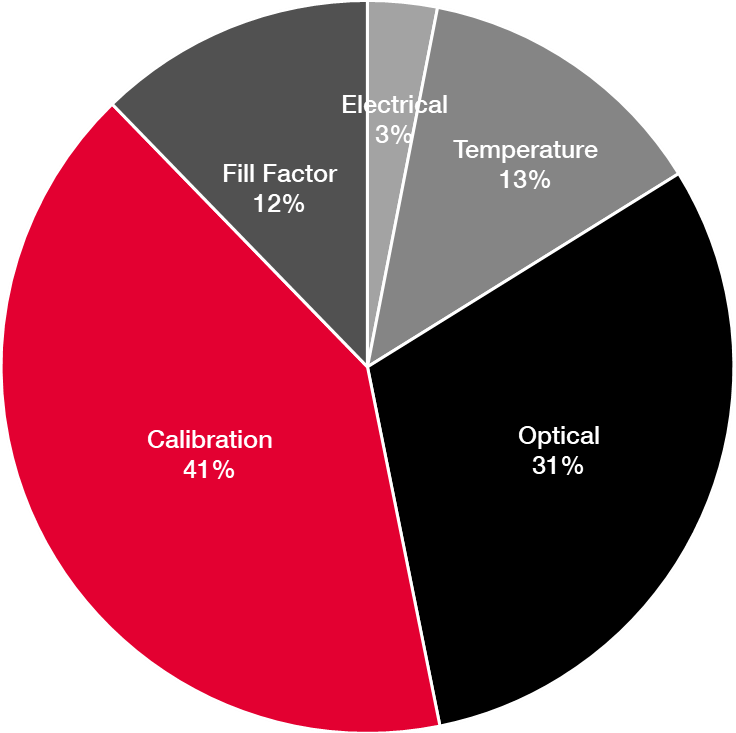
Pasan's DragonBack method measures highly capacitive cells and perovskite modules without transient error, using far fewer flashes than conventional multi-flash. SmartSweep picks the right method automatically for the device on the bench, so the operator does not have to know in advance whether they are measuring PERC, HJT or perovskite. The result is lower uncertainty, fewer flashes, and a power rating that means the same thing tomorrow.