
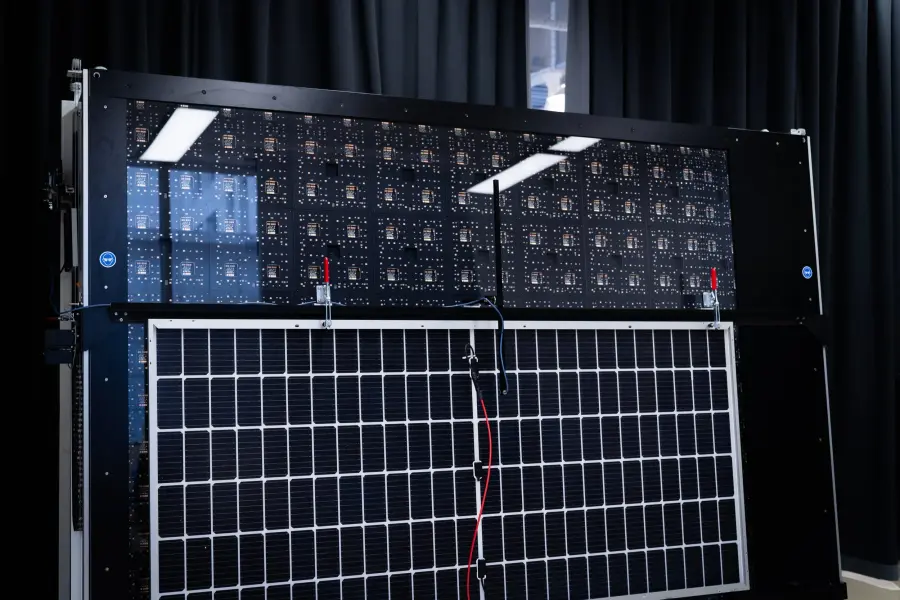
One xenon platform.
From cell to space.
The same measurement core, packaged for every job in photovoltaics, so a result is the same wherever it is taken.
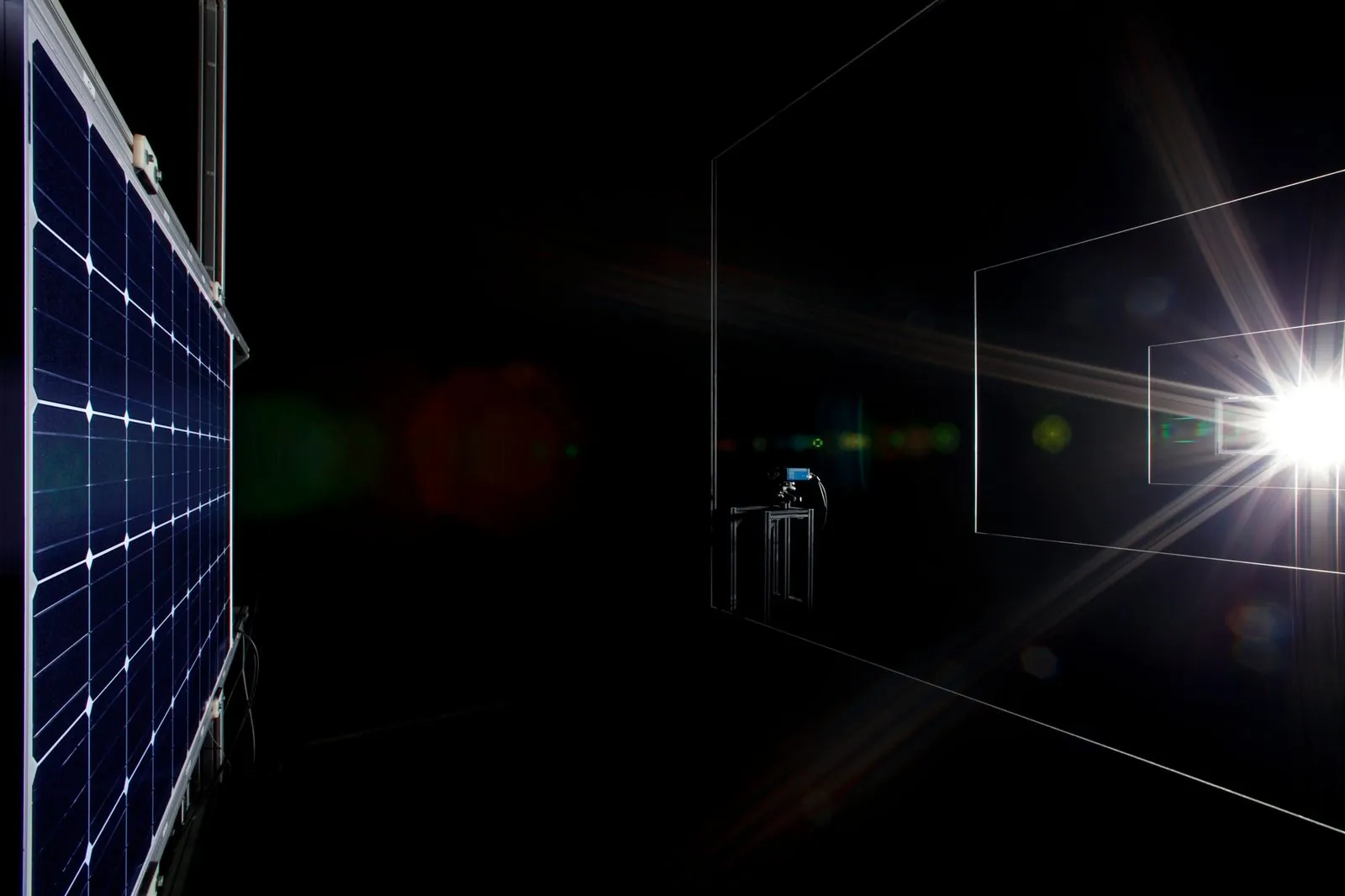
HighLIGHT 100ms Lab · 100ms Lab
The HighLIGHT 100ms Lab is a long-pulse xenon solar simulator built for calibration-grade module I-V testing. A 40 to 100 ms plateau is long enough to measure the most capacitive cells (HJT, TOPCon) without hysteresis, classified A+A+A+ under IEC 60904-9, with the thermal chamber, spectral-response and incidence-angle options that make it a complete PV characterisation laboratory in one Swiss-made instrument.
- ▸Pulse length40 – 100 ms plateau
- ▸ClassA+A+A+ (IEC 60904-9)
- ▸Test areaup to 2.8 × 1.6 m
- ▸MethodsDragonBack® · SmartSweep

HighLIGHT 100ms Prod · 100ms Prod
The HighLIGHT 100ms Prod is a production-line xenon solar simulator that carries the same measurement core as the Pasan laboratory reference. It holds A+A+A+ optical performance (IEC 60904-9) at a 15-second cycle, so every module is bin-sorted and traceable without slowing the line, and the nameplate watt you ship is the watt you measured.
- ▸Usein-line module power rating
- ▸Pulse40 – 100 ms plateau
- ▸ClassA+A+A+
- ▸Cycle time≈ 15 s / module
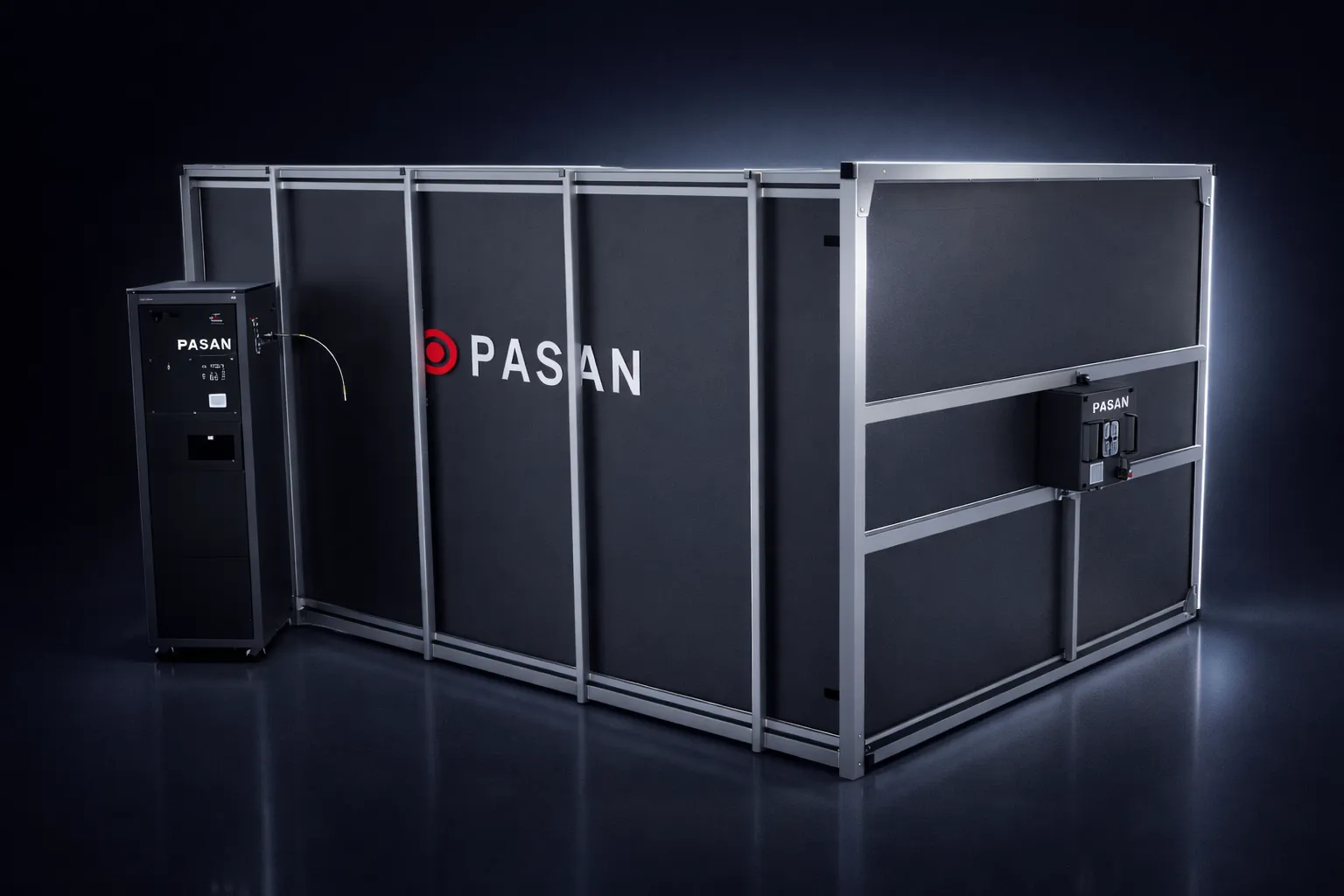
HighLIGHT A++ Reference · Reference Light
The HighLIGHT A++ Reference is the xenon solar simulator the PV industry calibrates against. Since 2008, tier-1 laboratories worldwide have used it to define what accurate means for a solar module: A++A++A++ under IEC 60904-9, twice as good as Class A, traceable to METAS (the Swiss federal metrology institute) under ISO/IEC 17025. Designed, built and calibrated in Switzerland, it is delivered worldwide with no export-licence exposure.
- ▸ClassA++A++A++ (IEC 60904-9)
- ▸Spectral match0.9375 – 1.0625 (±6.25%)
- ▸Performance≈ 2× better than Class A
- ▸TraceabilityMETAS · ISO/IEC 17025
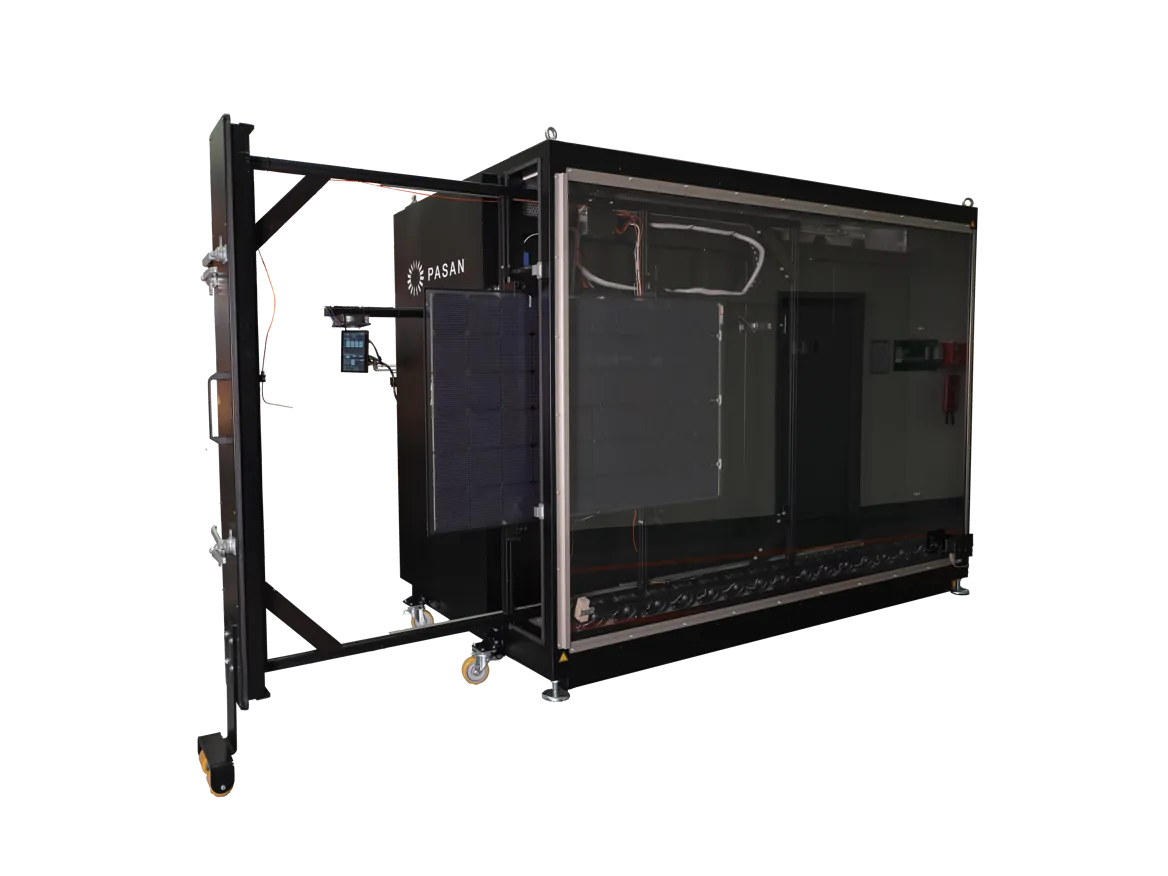
Thermal Chamber · TCS
Measure how a module behaves across its real operating range. The Pasan Thermal Conditioning System conditions full-size modules from 15 to 75 °C with ±1 °C uniformity, so temperature coefficients and the IEC 61853 matrix are measured in the same instrument, no transfer, no extra uncertainty.
- ▸Temperature range15 – 75 °C
- ▸Uniformity±1 °C
- ▸StandardsIEC 61215 · IEC 61853-1
- ▸Test areaup to 2.8 × 1.6 m
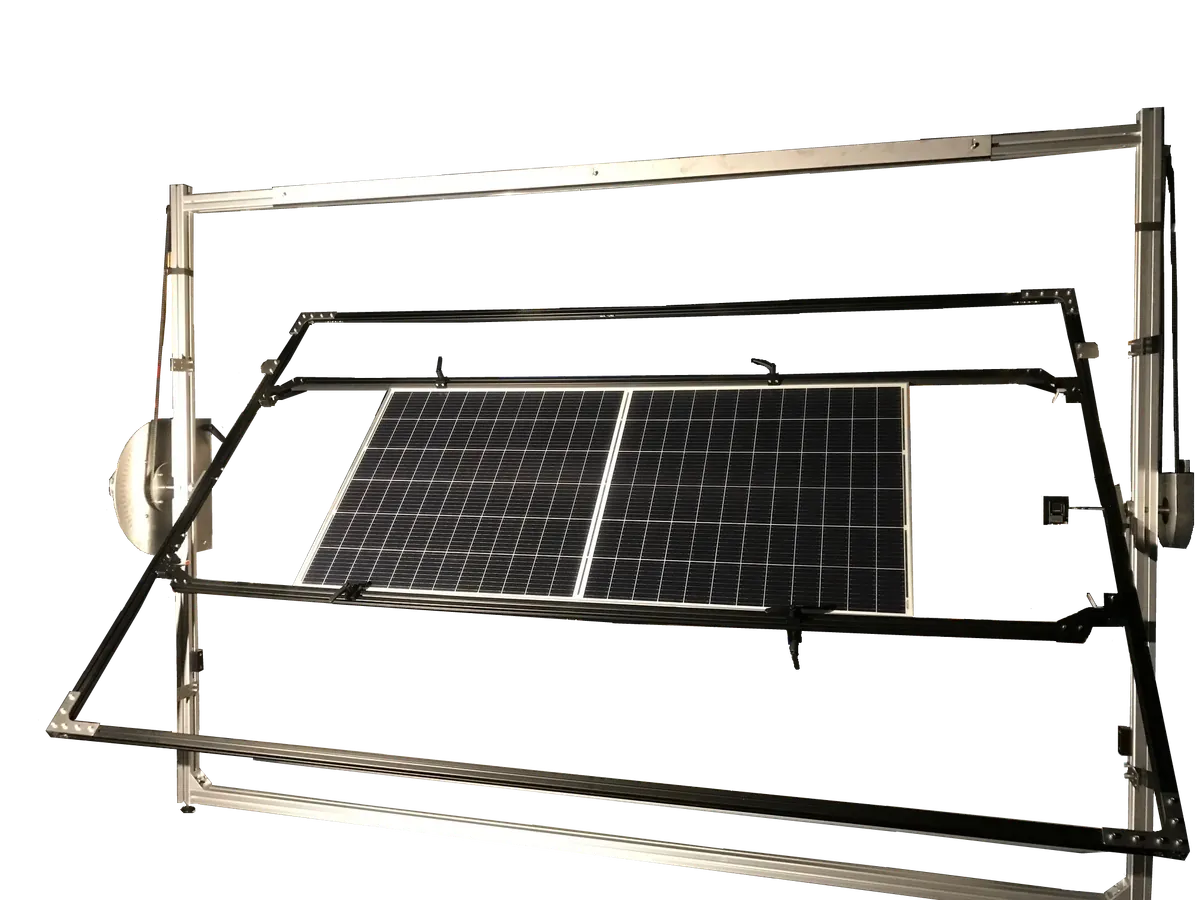
IAM · Incidence Angle Modifier
Sunlight rarely hits a module head-on. The IAM system rotates a full-size module through the simulator beam to measure how output changes with the angle of incidence, the incidence-angle modifier required by IEC 61853-2 and by every serious energy-yield model, and the same fixture that characterises bifacial gain.
- ▸Measurementoutput vs angle of incidence
- ▸Range±90° rotation
- ▸StandardIEC 61853-2
- ▸Alsobifacial angular response

HighLIGHT AM0
When you need to measure space solar cells, the HighLIGHT AM0 is the reference choice. Outside the atmosphere there is no air-mass attenuation: the AM0 spectrum is bluer and stronger than the terrestrial AM1.5, at roughly 1367 W/m² (the solar constant). The HighLIGHT AM0 reproduces it faithfully with filtered xenon sources, so the efficiency you measure on the ground is the power the cell will deliver in orbit. It is built by Pasan SA, the Swiss solar-reference house since 1978 and a trusted partner to space programmes since 2008, with full I–V characterisation traceable to SI through space reference cells.
- ▸SpectrumAM0 (extraterrestrial)
- ▸Irradiance≈ 1367 W/m² (1 AU)
- ▸Devicesspace-qualified solar cells
- ▸OutputsJsc, Voc, fill factor, η
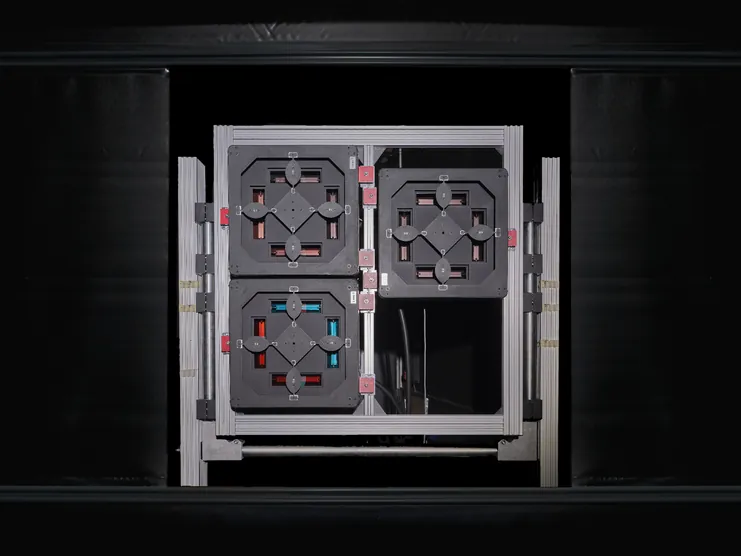
HighLIGHT SAT · Multi-junction 3/4/5J
The sun, the way a satellite sees it, at array scale. HighLIGHT SAT is a large-area AM0 platform for the multi-junction cells and panels that power spacecraft, current-matching every junction so the limiting current and the true efficiency are what you measure, not an artefact of the lamp.
- ▸SpectrumAM0, per-junction tuned
- ▸Junctions3J / 4J / 5J
- ▸Scalecell to full panel
- ▸MaterialsGaInP / GaAs / Ge and beyond
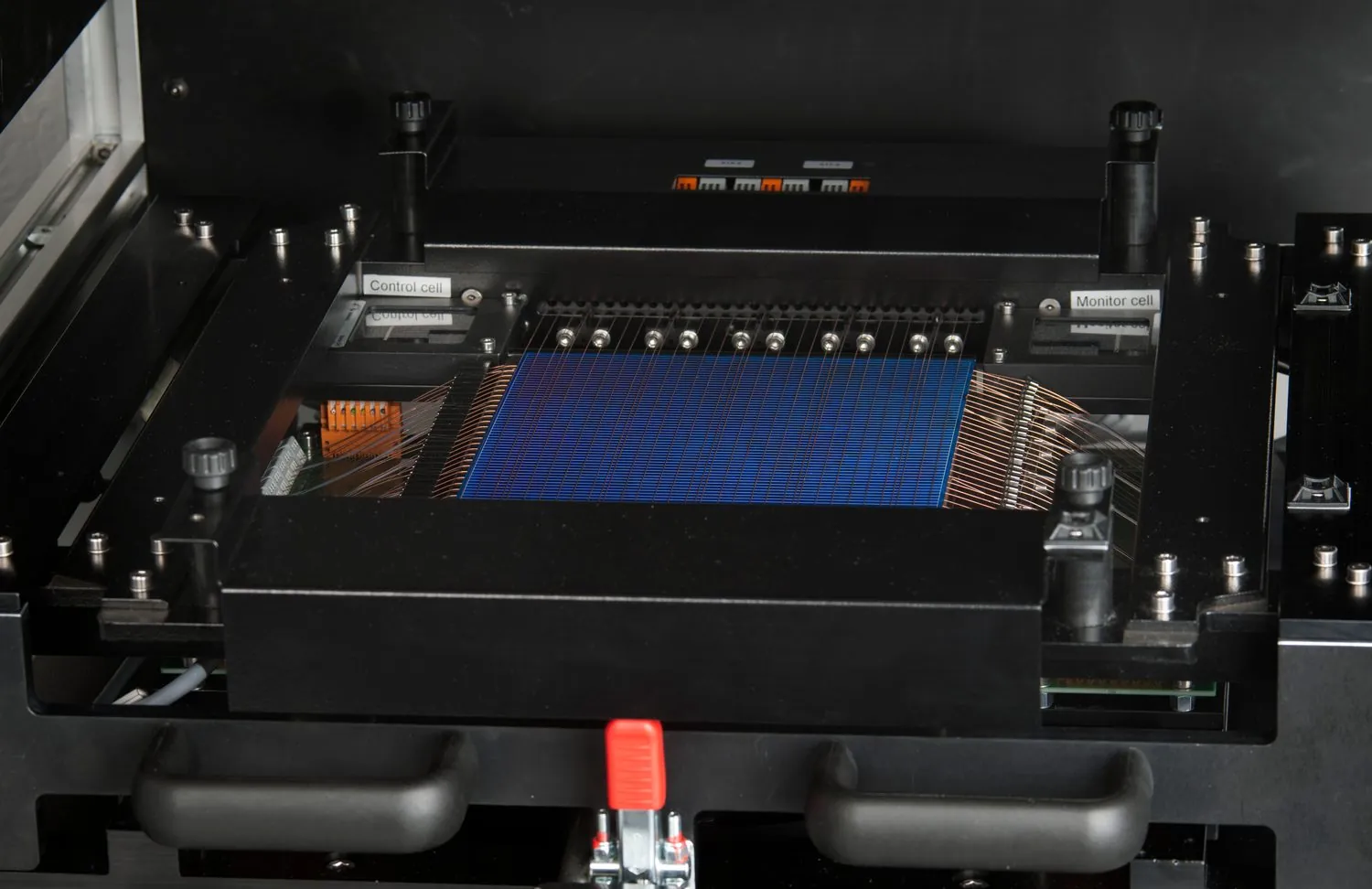
SpotLIGHT · Cell Tester
Built for the cell line. SpotLIGHT was the first xenon tester able to measure high-capacitance cells without the transient error that corrupts a standard flash, compact enough for the lab, fast enough for production, and ready for PERC, HJT, TOPCon, bifacial and curved cells.
- ▸Devicesingle solar cell
- ▸Light sourcepulsed xenon
- ▸CellsPERC · HJT · TOPCon · bifacial
- ▸Capacitive cellsDragonBack® supported
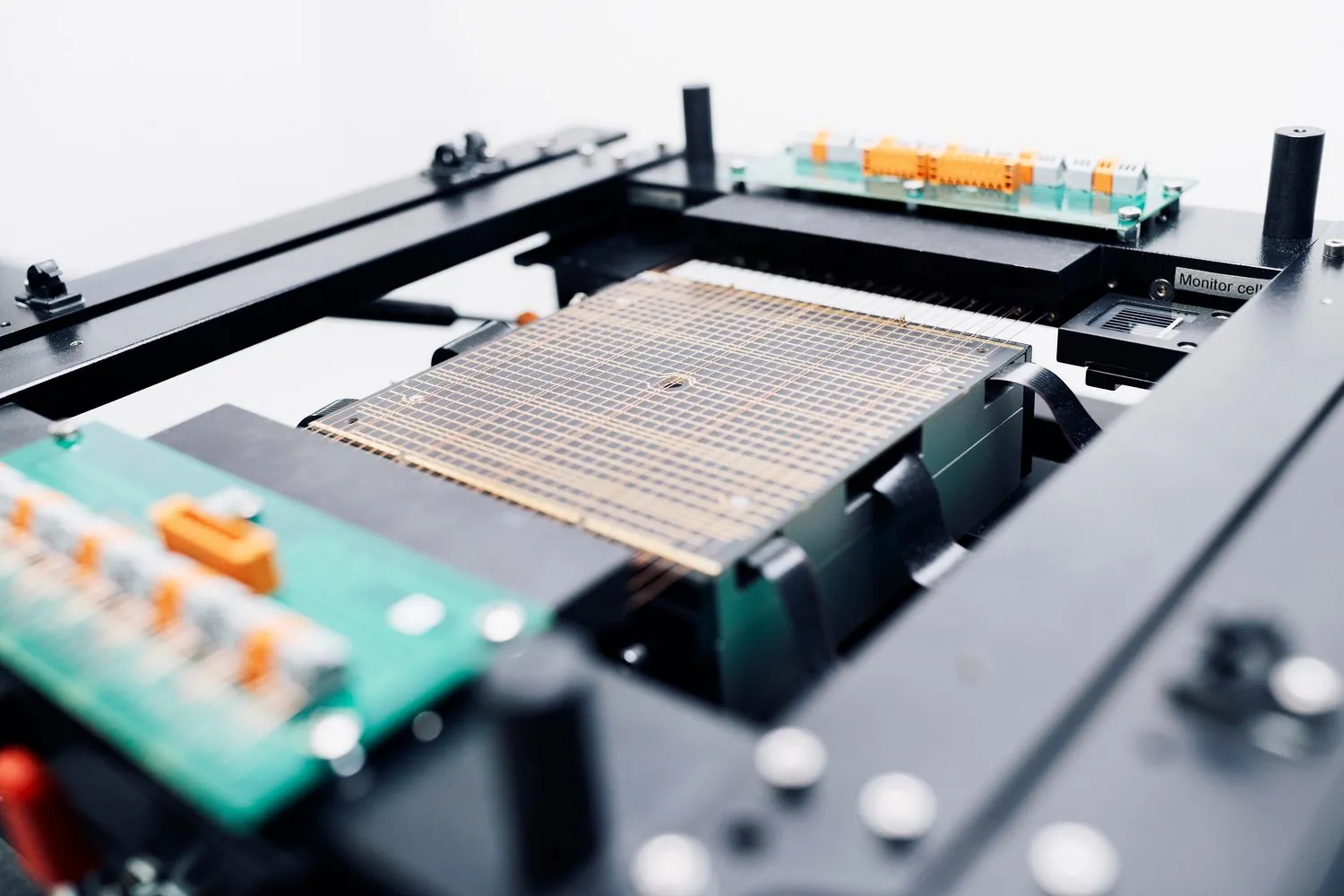
GridTOUCH
Modern busbarless and heterojunction cells can't be soldered for a measurement without losing yield. GridTOUCH makes temporary, spring-loaded contact to the cell grid, full-curve IV in under a second, with no permanent marks, so you can sort and characterise next-generation architectures without sacrificing the device.
- ▸Contactspring-loaded probe array
- ▸Cellsbusbarless · HJT · bifacial
- ▸Measurementfull I–V in < 1 s
- ▸Damagenone (non-invasive)
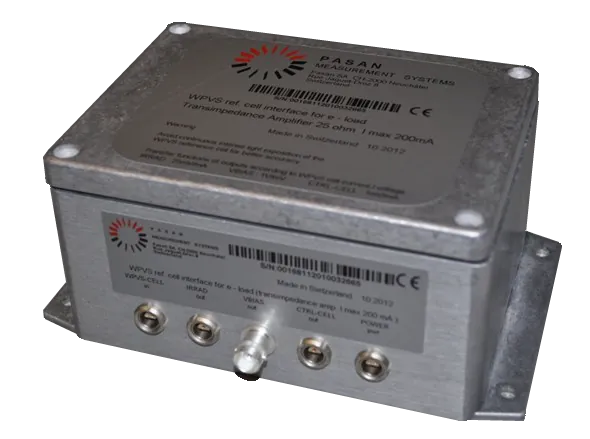
WPVS Transimpedance Amplifier · TIA
This is the small box that lets a lab pass ISO certification. The WPVS transimpedance amplifier converts the photocurrent of a non-shunted WPVS reference cell into a precise voltage with ±0.1% uncertainty, removing the shunt-resistance drift that otherwise corrupts the calibration chain, and giving every Pasan simulator unbroken traceability back to METAS and the SI.
- ▸Transimpedance25 Ω monitor / 1 Ω control
- ▸Accuracy±0.1% @ 25 °C
- ▸Current range20 – 180 mA (sink)
- ▸TraceabilityMETAS-certified
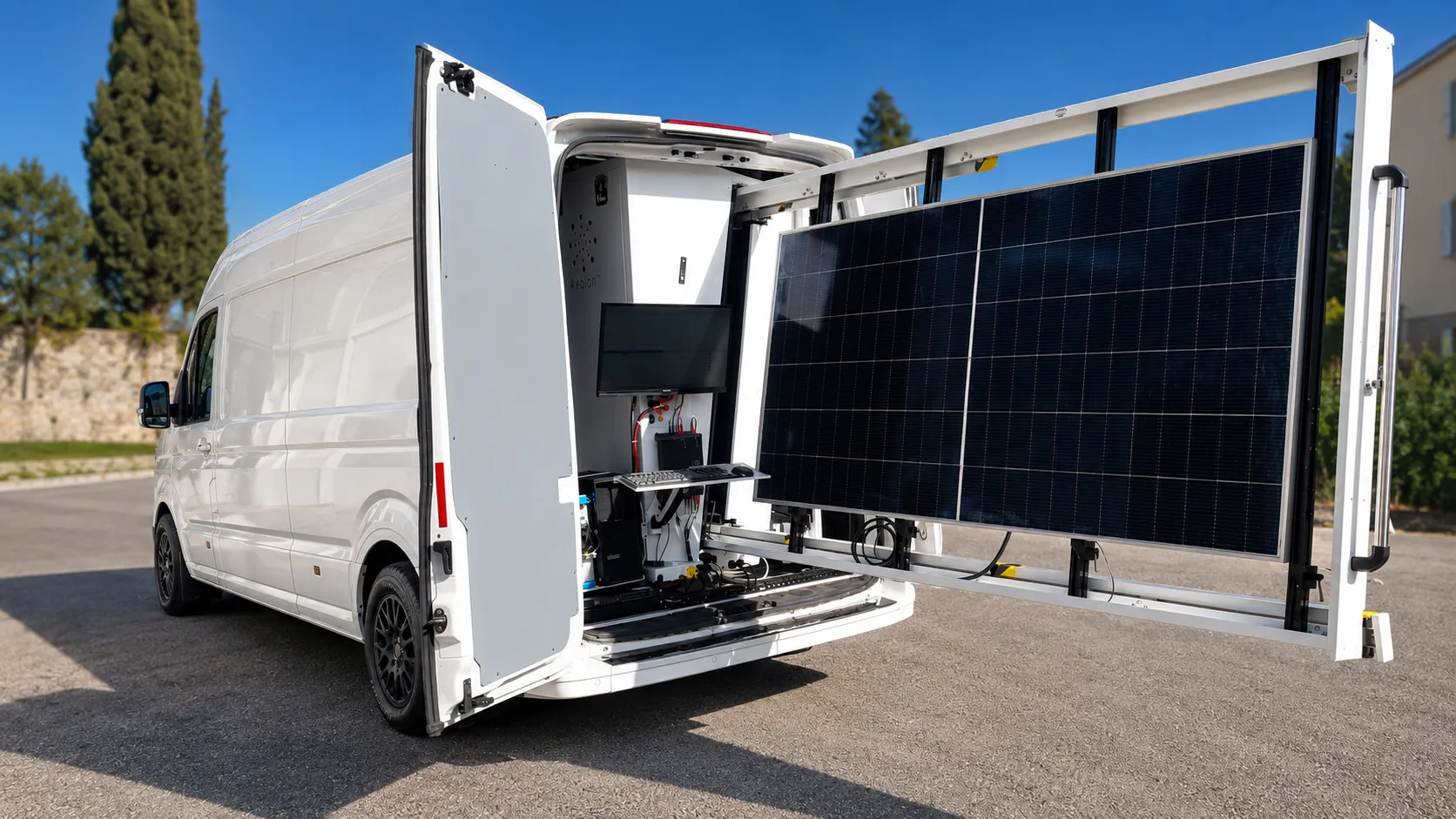
Mobile Lab
A complete flash-test laboratory built into a van, trailer or container, so accredited-grade PV measurement comes to the modules, on site, anywhere.
- ▸WhereOn site, the lab comes to you
- ▸MeasuresIV power rating, EL imaging and hipot
- ▸FormatsVan · trailer · container
What completes the measurement.
Upgrades that turn a flasher into a full characterisation lab, defect imaging, low-light, spectral response, temperature and angle.
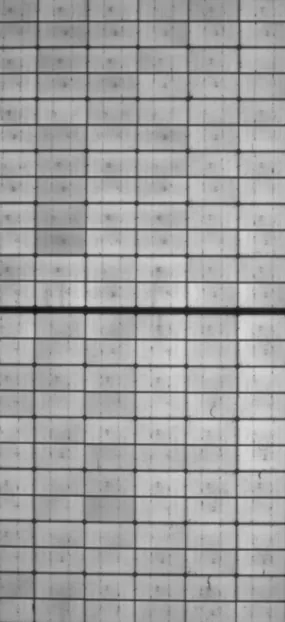
Reveal microcracks, broken fingers and inactive areas, defects invisible to a power measurement alone.
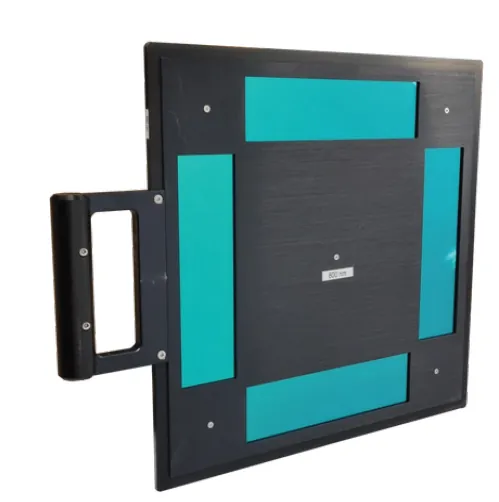
Calibrated masks step irradiance from −10% to −90% to characterise low-light behaviour and linearity, keeping A+ performance.
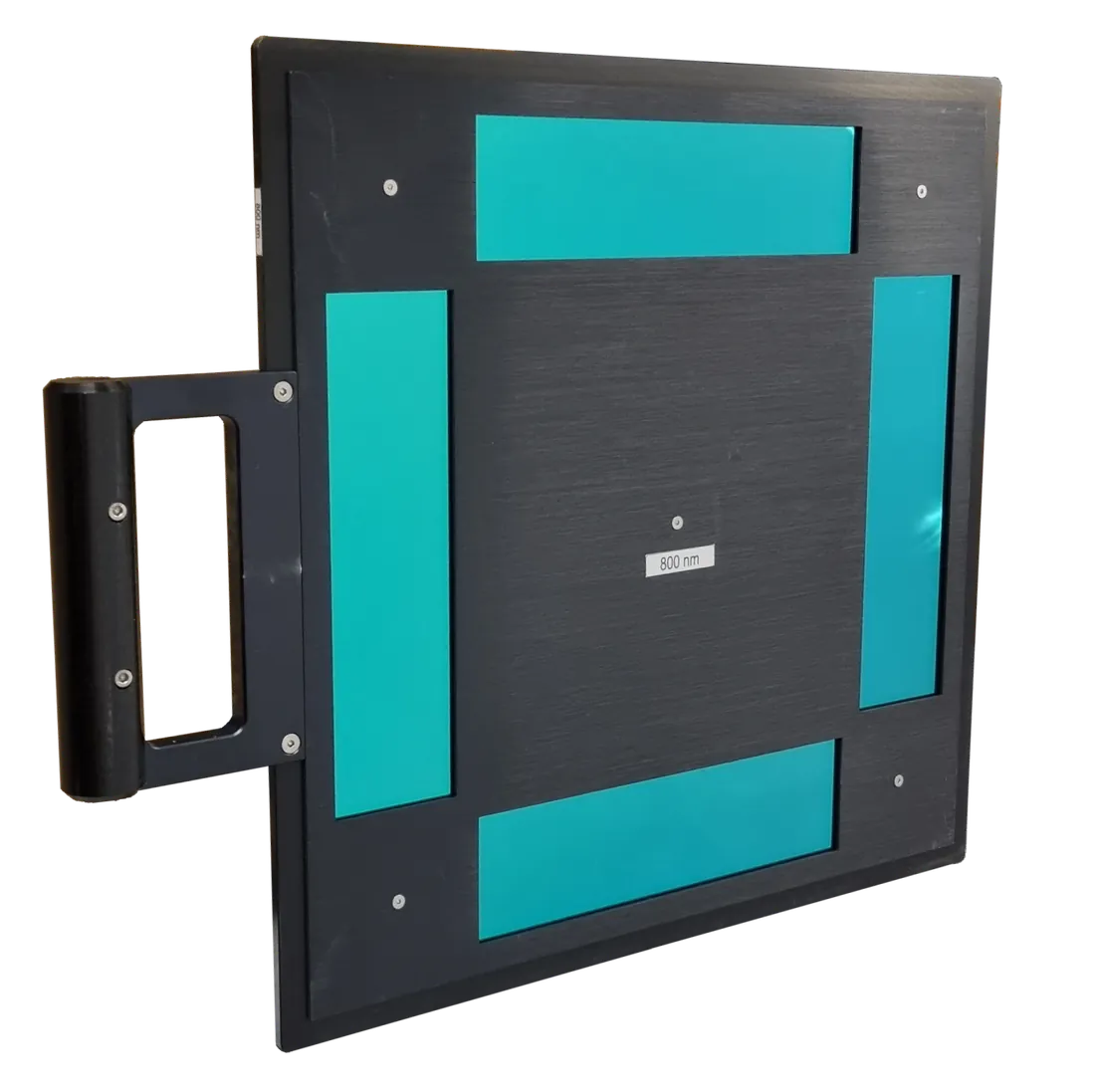
A 15-filter set (400–1100 nm) for non-destructive spectral-response measurement at full module level, per IEC 60904-7.