
HighLIGHT AM0
When you need to measure space solar cells, the HighLIGHT AM0 is the reference choice. Outside the atmosphere there is no air-mass attenuation: the AM0 spectrum is bluer and stronger than the terrestrial AM1.5, at roughly 1367 W/m² (the solar constant). The HighLIGHT AM0 reproduces it faithfully with filtered xenon sources, so the efficiency you measure on the ground is the power the cell will deliver in orbit. It is built by Pasan SA, the Swiss solar-reference house since 1978 and a trusted partner to space programmes since 2008, with full I–V characterisation traceable to SI through space reference cells.
 AM0 · ≈1367 W/m² · space cells
AM0, the sun before the sky changes it.
Earth's atmosphere absorbs and scatters specific bands; a satellite never sees that filtering. Qualifying space hardware means reproducing AM0 across every sub-cell's response band, so the measured efficiency is what the cell will actually deliver in orbit. The HighLIGHT AM0 holds the spectral match across the full response range of modern multi-junction cells, the requirement that separates a usable space-cell measurement from a misleading one.
- ▸Reference spectrumAM0
- ▸Irradiance≈ 1367 W/m²
- ▸Sourcesfiltered xenon / multi-source
- ▸Calibrationspace reference cells
Space sees a single sun, not a diffuse sky.
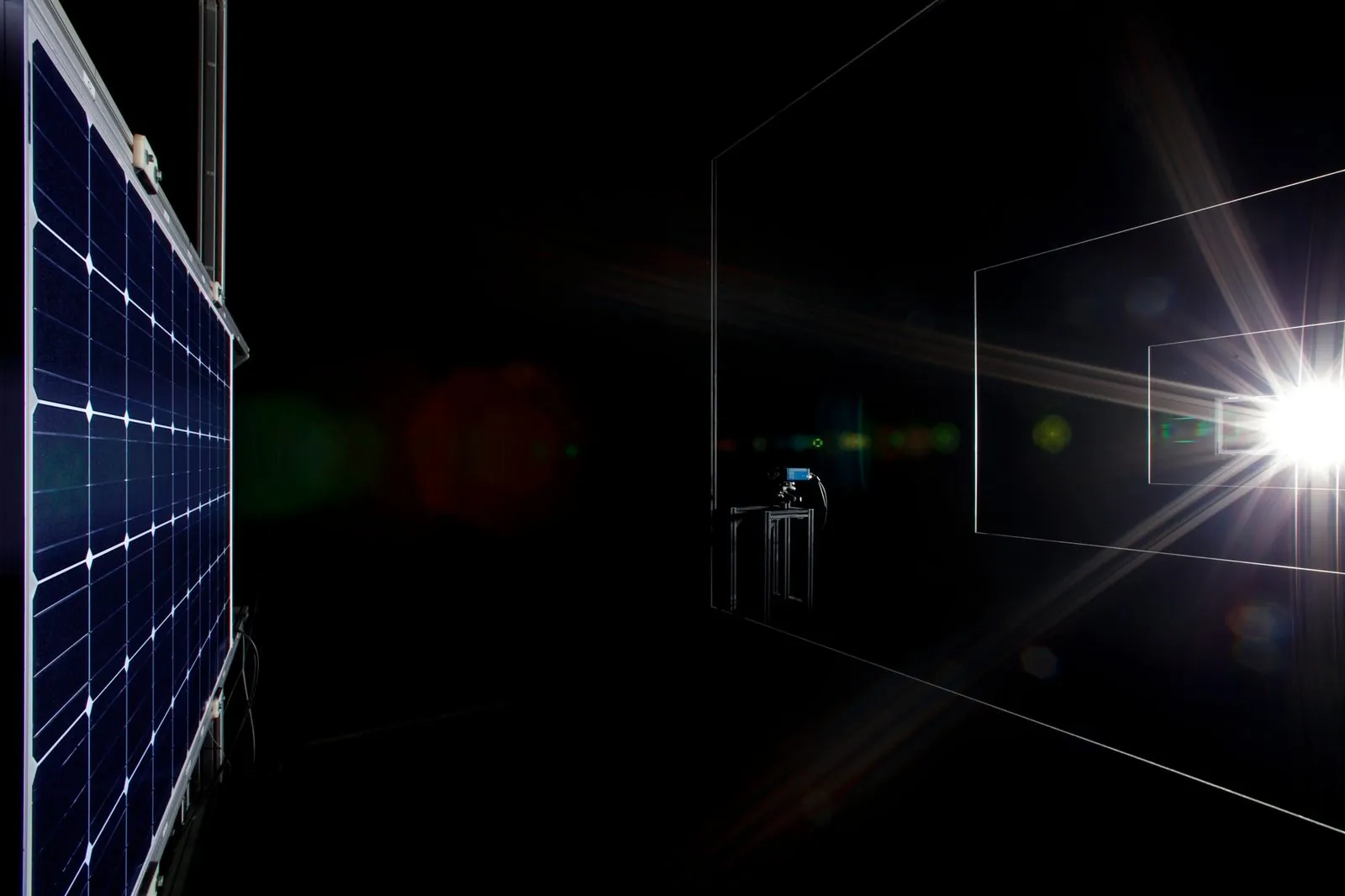
In orbit, sunlight arrives as a near-parallel beam from one point in the sky: the sun subtends only about half a degree, with no scattered, diffuse component. The HighLIGHT AM0 reproduces that geometry. A xenon arc is effectively a single point source, so its light reaches the cell with low angular divergence, close to the directional sunlight a satellite actually receives. This matters for the lowest measurement uncertainty: space cells carry cover glass, anti-reflective coatings and textured surfaces whose reflection and refraction depend on the angle of incidence, so light from a single direction tracks in-orbit behaviour more tightly than light spread across many angles. LED simulators excel across a wide range of terrestrial and laboratory work, and Avalon ST's Nexun line builds on exactly that strength; for AM0 space-cell qualification specifically, the directional xenon beam is what delivers the tightest uncertainty budget.
- ▸Light sourcesingle xenon arc (point source)
- ▸Beam geometrylow divergence, near-collimated
- ▸Best fitlowest uncertainty for AM0 cells
- ▸Why it mattersangle-dependent optics on cover glass
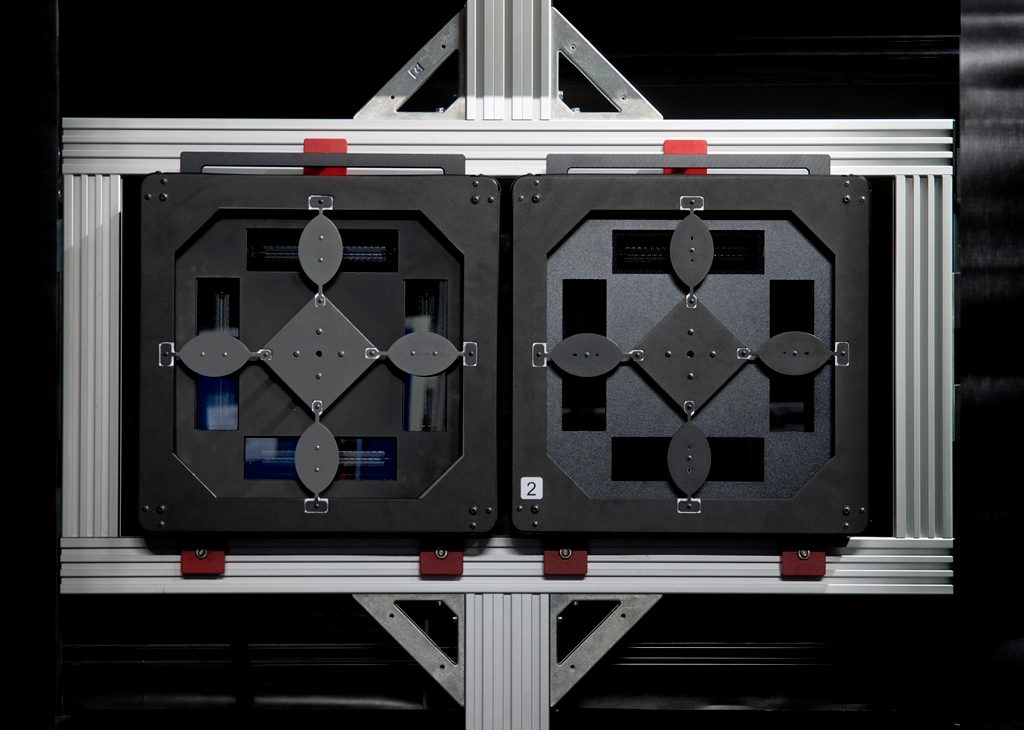
The measurement space programmes rely on.
The HighLIGHT AM0 characterises single-junction and multi-junction space cells with the accuracy mission power budgets demand. It is the natural starting point of the Pasan space line: cells qualified here scale up to the HighLIGHT SAT platform that tests full multi-junction arrays and panels. Backed by Pasan's Swiss manufacturing, long calibration heritage and worldwide service, it is a low-risk choice for agencies, integrators and cell manufacturers who cannot afford a measurement error to reach orbit.
- ▸Cellssingle & multi-junction
- ▸Measurementfull I–V under AM0
- ▸Scale upHighLIGHT SAT (panels)
- ▸Heritagespace testing since 2008