




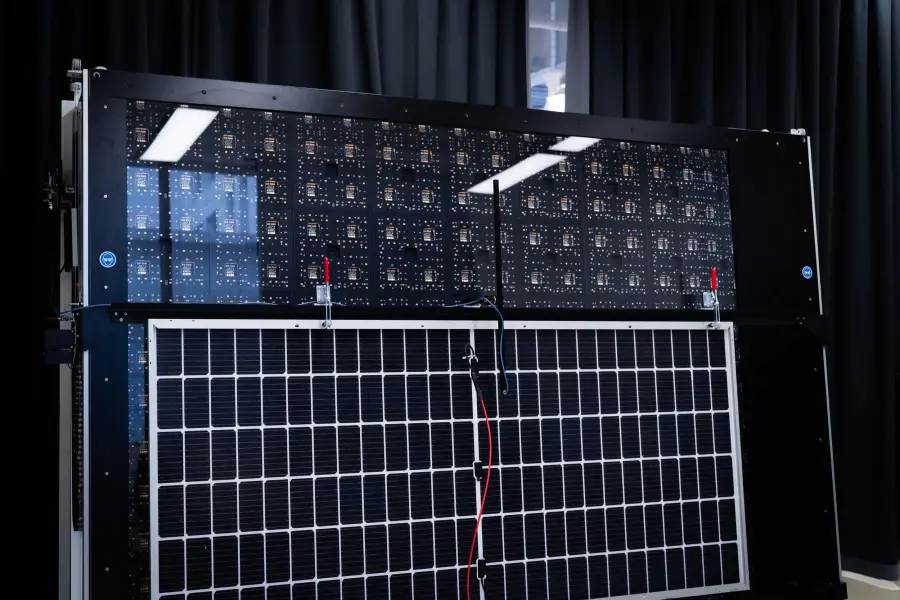
 Electroluminescence Imaging
The measurement problem
Specification sheets, test reports and contracts mix these terms. A buyer comparing a supplier's repeatability with another's uncertainty compares nothing; a power rating without uncertainty and traceability cannot be defended.
The physics behind it
| Term | What it answers | Typical PV example |
|---|---|---|
| Repeatability | Does the system give the same number twice, same conditions, short interval? | Standard deviation of repeated flashes on one module |
| Intermediate precision | Is the laboratory stable over weeks, operators, recalibrations? | Control module measured every week |
| Reproducibility | Do different laboratories or instruments agree? | Intercomparison: c-Si within ±0.5 % among reference laboratories in 2017 [2] |
| Calibration uncertainty | How well is the reference device known? | 0.23 to 0.4 % for primary reference cells (k = 2) [3][4] |
| Measurement uncertainty | How far could the result be from the true value? | ±1.1 % for accredited monofacial module Pmpp [5] |
| Traceability | Is the result linked to the SI by an unbroken, documented chain? | IEC 60904-4 chain from radiometry to working reference [6] |
| Simulator class | Does the light stay within set bounds? | IEC 60904-9 A+, A, B, C; does not predict power uncertainty [7] |
What the measurement must achieve
- A model equation for Pmax at STC with every input: reference calibration, mismatch, non-uniformity, temporal instability, temperature, electrical measurement, device effects.
- Type A and Type B evaluations, sensitivity coefficients, correlations, combined and expanded uncertainty with the coverage factor stated (GUM).
- Traceability of every calibrated input.
- Validation by intercomparison.
Applicable standards
| Standard | What it governs here |
|---|---|
| JCGM 100:2008 (GUM)Evaluation of measurement data: Guide to the expression of uncertainty in measurement | Evaluation and expression of uncertainty. |
| JCGM 200:2012 (VIM)International vocabulary of metrology | Definitions of repeatability, reproducibility, uncertainty, calibration, traceability. |
| ISO/IEC 17025:2017General requirements for the competence of testing and calibration laboratories | Laboratory requirements for traceability and uncertainty. |
| IEC 61215-1:2021Terrestrial PV modules, design qualification and type approval: test requirements | Gate decisions with reproducibility r and uncertainty m1 per technology. |
| IEC 60904-4:2019Procedures for establishing calibration traceability of PV reference devices | Traceability chain for PV reference devices. |
Measurement technologies: advantages and limitations
The light source changes some terms (temporal instability, spectral data, heating) but rarely dominates a well-run budget: reference calibration and spectral mismatch lead for crystalline silicon [8], preconditioning for thin film [2], capacitance for high-efficiency silicon when the method is not validated [9].
Where Pasan equipment fits
- Uncertainty budget guideHow to read a simulator uncertainty budget term by term.
- HighLIGHT A++ ReferenceMETAS-traceable reference simulator.
Technical questions
- Is repeatability the same as accuracy?
- No. Repeatability is agreement under identical conditions; accuracy is closeness to the true value, quantified by the measurement uncertainty, which includes the reference calibration.
- What do IEC 61215 r and m1 mean?
- The maximum reproducibility and measurement uncertainty allowed in gate decisions: 1.0 % and 3.0 % for c-Si, 2.0 % and 4.0 % for single-junction CdTe, a-Si and CIGS [1][10].
- Why must an uncertainty state its coverage factor?
- Because ±1 % at k = 1 and ±1 % at k = 2 are different statements; without k, two figures cannot be compared.
References
- , “IEC 61215-1:2021, IEC 61215-1-1:2021 and IEC 61215-2:2021, Terrestrial photovoltaic modules: design qualification and type approval”, International Electrotechnical Commission, 2021. Source
- , “Improvements in world-wide intercomparison of PV module calibration”, Solar Energy 155, 1451-1461, 2017. doi:10.1016/j.solener.2017.07.081
- , “Reduction of uncertainties for photovoltaic reference cells”, Metrologia 52, 646-653, 2015. doi:10.1088/0026-1394/52/5/646
- , “Design, realization and uncertainty analysis of a laser-based primary calibration facility for solar cells at PTB”, Measurement 51, 457-463, 2014. doi:10.1016/j.measurement.2013.12.001
- , “CalLab PV Modules (accredited calibration laboratory), web page accessed November 2026”, Fraunhofer ISE, 2026. Source
- , “IEC 60904-4:2019, Photovoltaic reference devices: procedures for establishing calibration traceability (edition 2.0)”, International Electrotechnical Commission, 2019. Source
- , “IEC 60904-9:2020, Photovoltaic devices, Part 9: Classification of solar simulator characteristics (edition 3.0)”, International Electrotechnical Commission, 2020. Source
- , “Analysis and mitigation of measurement uncertainties in the traceability chain for the calibration of photovoltaic devices”, Measurement Science and Technology 20, 075101, 2009. doi:10.1088/0957-0233/20/7/075101
- , “Electrical characterization intercomparison of high-efficiency c-Si modules within Asian and European laboratories”, Progress in Photovoltaics 27, 603-622, 2019. doi:10.1002/pip.3134
- , “IEC 61215-1-4:2021, Special requirements for testing of thin-film Cu(In,Ga)(S,Se)2 based photovoltaic modules”, International Electrotechnical Commission, 2021. Source
How this page is written: claims about physics and standards cite published sources, claims about Pasan equipment repeat only what the product pages state, and no other manufacturer is named. Editorial method