
 Electroluminescence Imaging
The measurement problem
Rear-side light adds current, so a bifacial rating needs more than an STC flash. Indoors, any light reaching the side that should be dark becomes a direct error, and the method used to emulate rear irradiance changes the result.
The physics behind it
Rear photocurrent adds to front photocurrent; bifaciality is a device property, unlike site albedo. Rear reflections from the test environment add unintended irradiance [1].
What the measurement must achieve
- Bifaciality coefficients for Isc, Voc and Pmax; equivalent irradiance based on the Isc bifaciality (2024 edition) [1].
- BNPI: 1000 W/m² front plus 135 W/m² rear for nameplate values; bifacial stress irradiance 1000 + 300 W/m² in IEC 61215 [2].
- Single-side method: irradiance adjustable above 1000 W/m² (typically up to 1200 W/m²), class B non-uniformity or better maintained at the levels used [1].
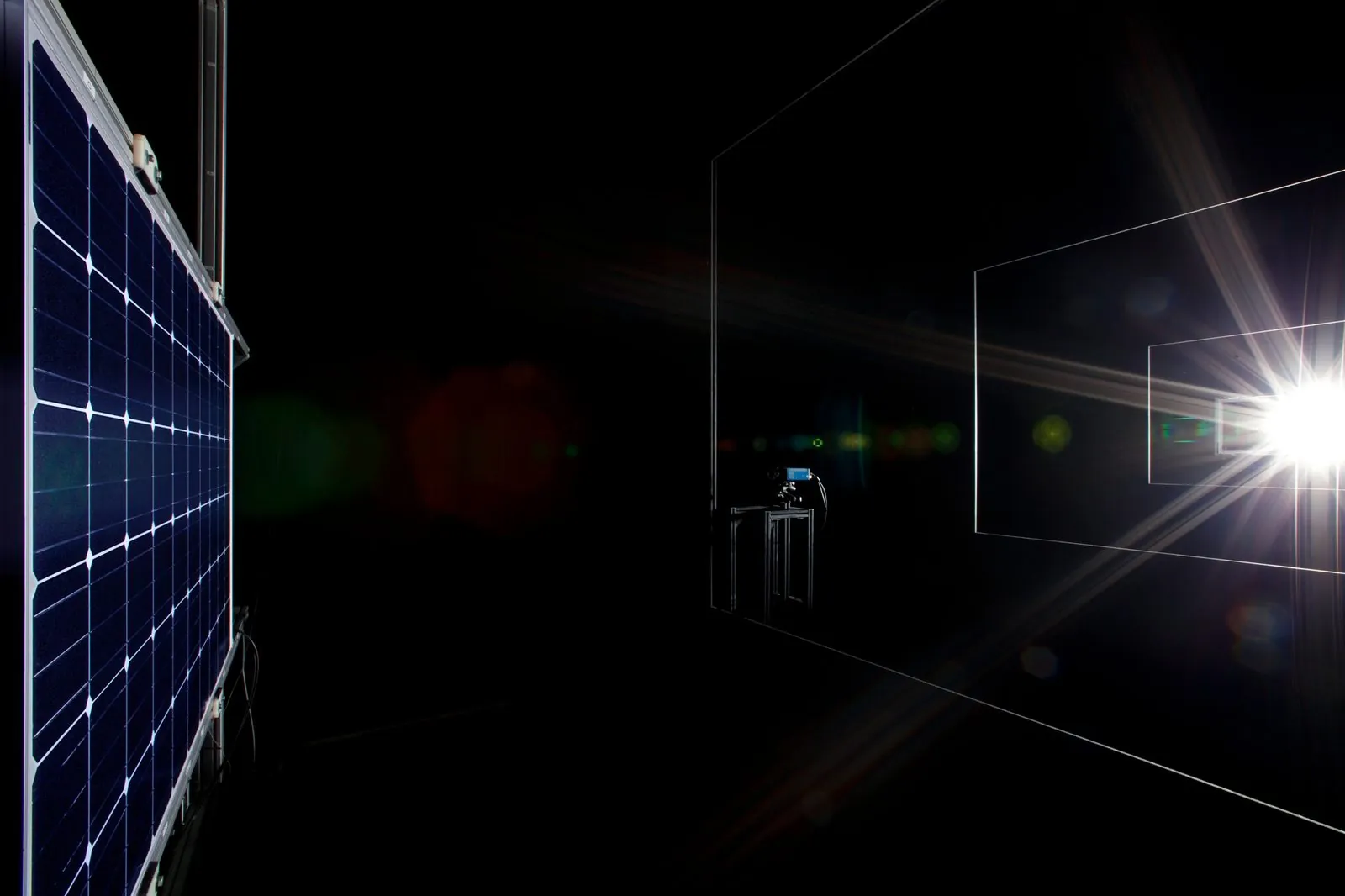
- Non-irradiated side: at most 5 W/m² at any point, checked at six points per m² or more [1].
- Double-side method: classification on both sides; opposite-side contributions above 5 W/m² corrected and included in the uncertainty.
- Spectral mismatch correction is no longer mandatory in the 2024 edition but must be considered in the uncertainty.
Applicable standards
| Standard | What it governs here |
|---|---|
| IEC TS 60904-1-2:2024Measurement of current-voltage characteristics of bifacial PV devices | The bifacial measurement methods, definitions (bifaciality, equivalent irradiance, BNPI, BiFi) and requirements. |
| IEC 61215-1:2021Terrestrial PV modules, design qualification and type approval: test requirements | Bifacial modules: nameplate at STC and BNPI; a module is bifacial if claimed or if Pmax bifaciality is 20 % or more. |
| IEC 60904-9:2020 (edition 3)Classification of solar simulator characteristics | Classification, to be stated at each irradiance level used (± 50 W/m²). |
| IEC TS 63202-3:2023Measurement of current-voltage characteristics of bifacial photovoltaic cells | Bifacial cells. |
Measurement technologies: advantages and limitations
Any source can perform the single-side method if it reaches about 1200 W/m² with maintained uniformity; pulsed xenon then needs calibrated operation at several flash levels, while LED sets irradiance electronically. In a JRC implementation study the methods agreed within 0.9 % in Pmax, except a double-source arrangement with a rear reflector (2.59 %), because of the rear irradiance measurement [3]. Fraunhofer ISE CalLab publishes an accredited Pmpp uncertainty of ±1.4 % for bifacial modules against ±1.1 % for monofacial [4].
Where Pasan equipment fits
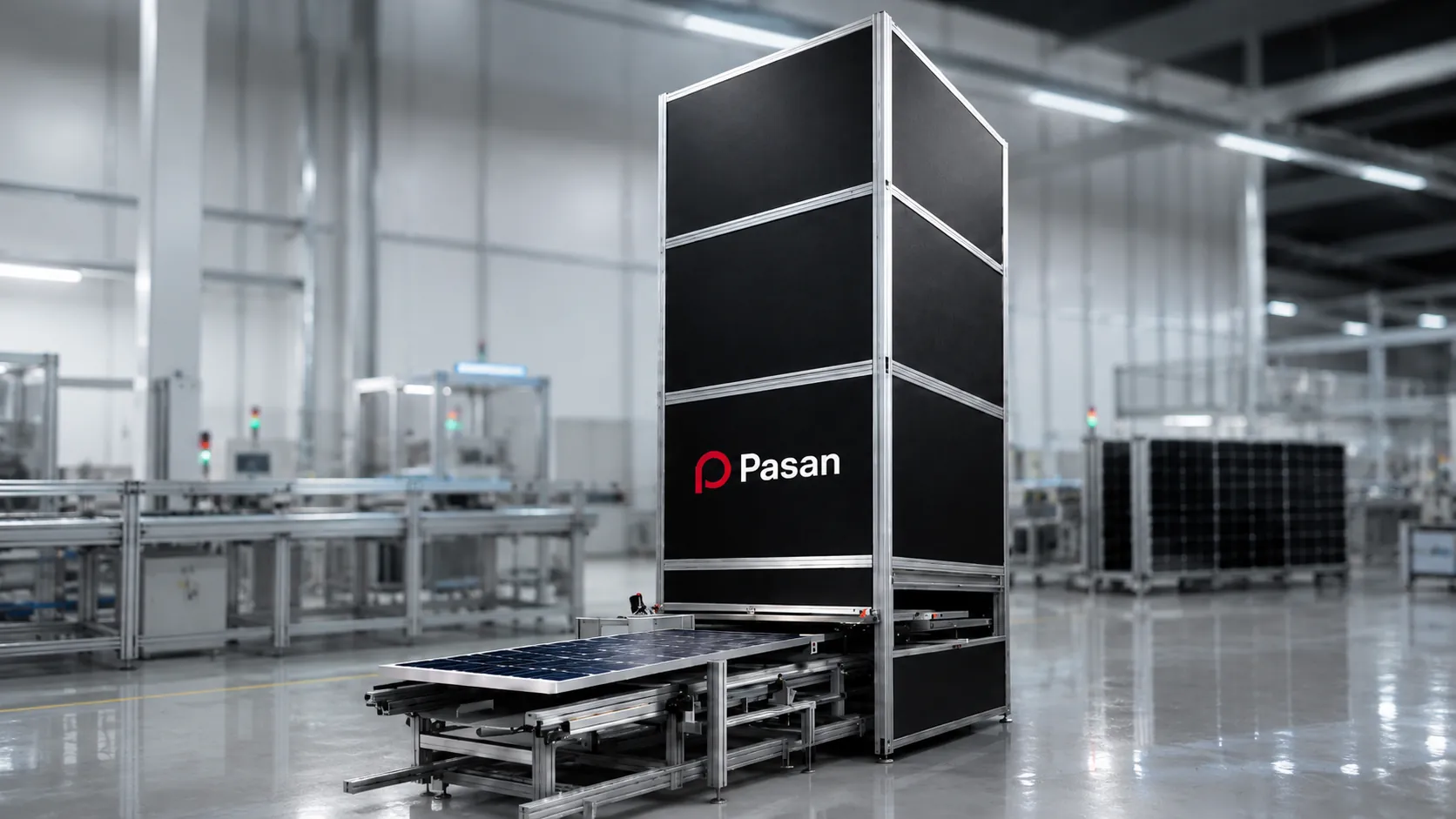
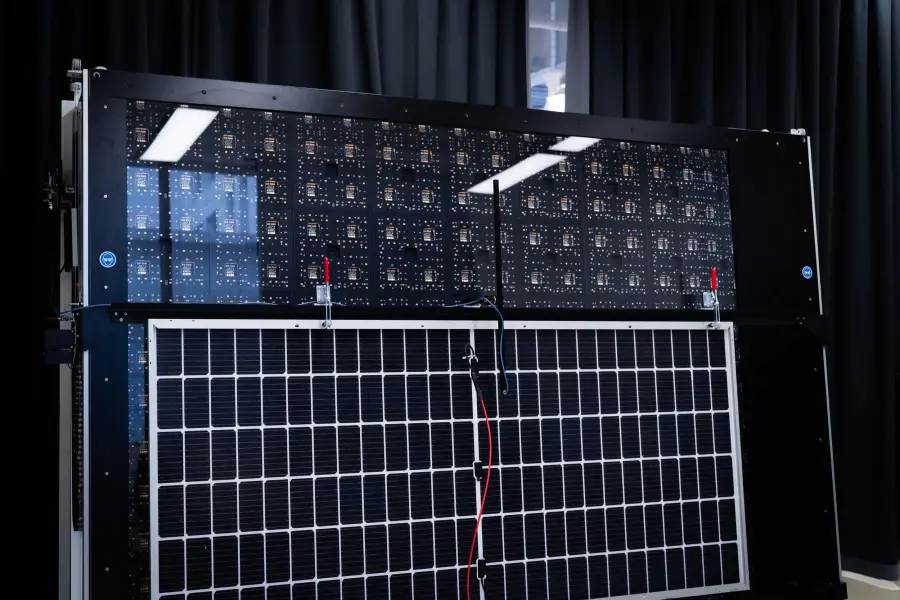
- HighLIGHT 100ms LabRotating holder for incidence-angle and bifacial response; anti-reflective back curtain for front-side isolation.
- IAM angular responseAngular response of full-size modules (IEC 61853-2).
Technical questions
- What is BNPI?
- Bifacial nameplate irradiance: 1000 W/m² on the front plus 135 W/m² on the rear [1].
- How dark must the non-illuminated side be?
- At most 5 W/m² at any point, checked with at least six points per m² [1].
- Can a single-side flasher measure bifacial modules?
- Yes, with the equivalent-irradiance method, provided irradiance can be raised above 1000 W/m² with class B uniformity or better at those levels.
- When is a module bifacial in IEC 61215?
- When the manufacturer claims it or its Pmax bifaciality is 20 % or more [2].
References
- , “IEC TS 60904-1-2:2024+AMD1:2026, Measurement of current-voltage characteristics of bifacial photovoltaic devices”, International Electrotechnical Commission, 2024. Source
- , “IEC 61215-1:2021, IEC 61215-1-1:2021 and IEC 61215-2:2021, Terrestrial photovoltaic modules: design qualification and type approval”, International Electrotechnical Commission, 2021. Source
- , “Implementation of the IEC TS 60904-1-2 measurement methods for bifacial silicon PV devices”, IEEE Journal of Photovoltaics 12, 787-797, 2022. doi:10.1109/JPHOTOV.2022.3161186
- , “CalLab PV Modules (accredited calibration laboratory), web page accessed November 2026”, Fraunhofer ISE, 2026. Source
How this page is written: claims about physics and standards cite published sources, claims about Pasan equipment repeat only what the product pages state, and no other manufacturer is named. Editorial method