

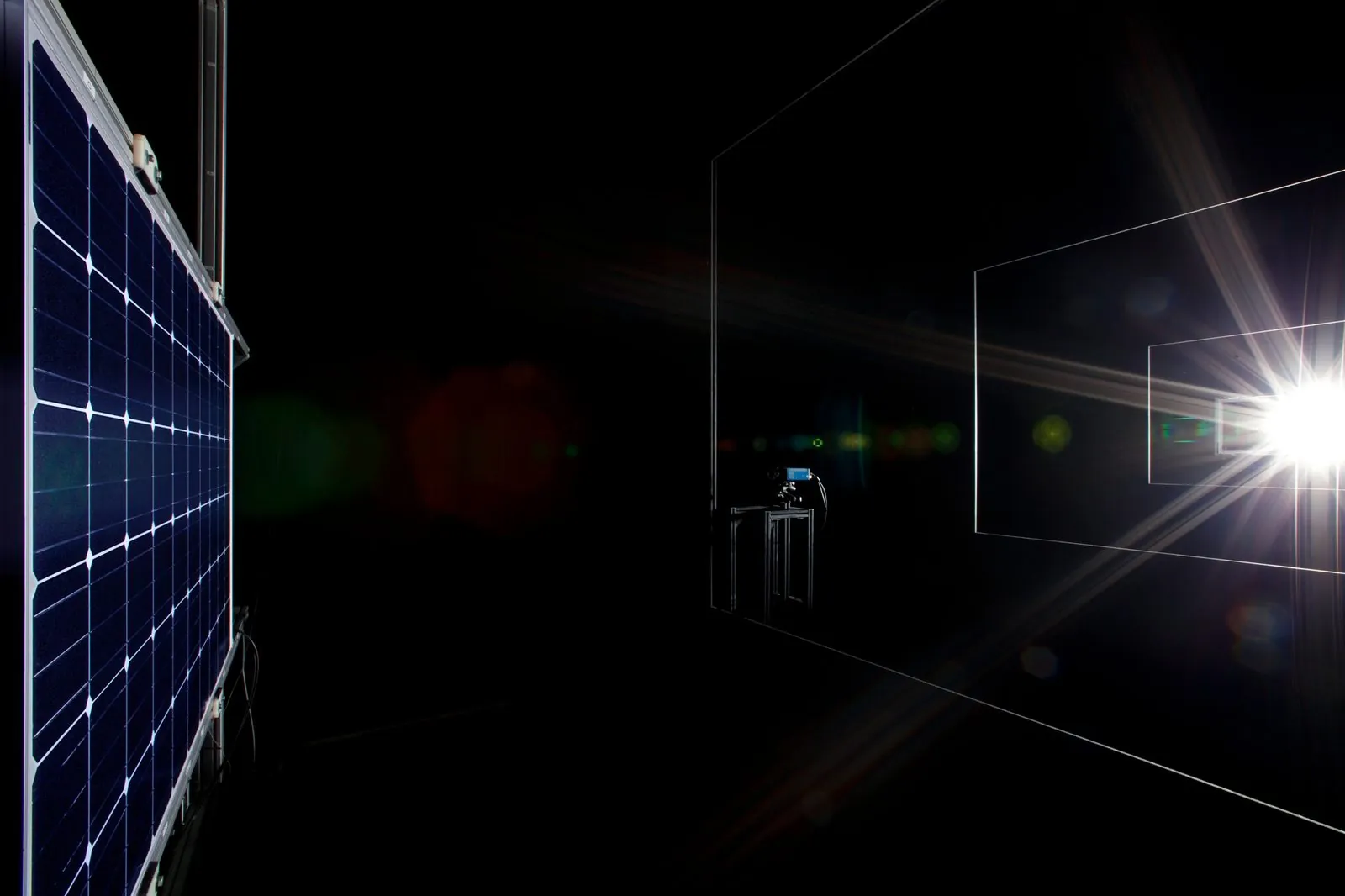


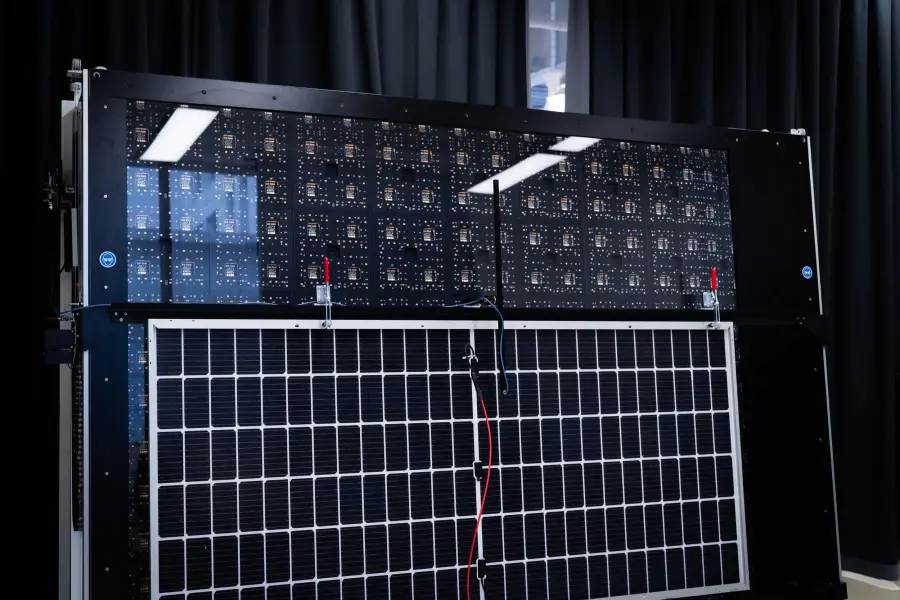
 Electroluminescence Imaging
The measurement problem
A CIGS module stored in the dark and then flashed can read several percent lower than the same module after light exposure, so its STC power depends on preconditioning as much as on the simulator.
The physics behind it
- Light- and bias-induced metastabilities in the absorber are explained by a vacancy complex switching between configurations, accounting for red-light, blue-light and reverse-bias effects [3].
- Buffer properties can drive large light-soaking metastability; in device studies only buffer variations reproduced the effects seen in commercial modules [4].
- Light soaking at 50 °C for 24 h raised Voc in ACIGS cells and lowered it in CIGS cells; the change partly reverted in the dark over months [5].
- The light-stabilised state depends on exposure temperature: up to 5.8 % for 20 °C for CIGS and CdTe modules [6].
What the measurement must achieve
- Controlled preconditioning: light soaking at controlled temperature, or forward-bias current injection in the dark, then a fixed short delay before the flash [2][7].
- At least three exposure intervals are likely needed for stabilisation [7].
- Store modules in the dark at 25 °C or below when a delay exceeds 1 h (IEC 61215-1-4 for hot-spot testing) [1].
- Spectral mismatch correction: CIGS responds further into the infrared than many references; measure the simulator spectrum over the whole spectral response range.
Applicable standards
| Standard | What it governs here |
|---|---|
| IEC 61215-1-4:2021Special requirements for thin-film Cu(In,Ga)(S,Se)2 (CIGS) modules | CIGS-specific requirements: special care for MQT 19 stabilisation, reproducibility 2.0 % and maximum uncertainty 4.0 % (single junction), dark-soak storage rules. |
| IEC 61215-2:2021Terrestrial PV modules, design qualification and type approval: test procedures | MQT 19 stabilisation and MQT 02 power measurement. |
| IEC 60904-7:2019Computation of the spectral mismatch correction | Spectral mismatch correction. |
Measurement technologies: advantages and limitations
A pulsed flash is well suited to the STC measurement itself because it neither heats nor further light-soaks the module, but it cannot precondition; a light-soak or bias station is needed. Steady-state light can combine both, provided the module temperature is controlled and the cool-down defined, since the light state depends on temperature [6]. No CIGS-specific comparison of LED and xenon sources was found.
Where Pasan equipment fits
- HighLIGHT 100ms LabLong-pulse I-V with module spectral response; current-injection preconditioning is described on Pasan pages for CdTe and uses the same principle.
- LED Light SoakerMQT 19 light soaking with MPP, Isc or Voc load bias.
Technical questions
- Why does my CIGS module read lower on the flasher than its label?
- Dark storage lowers CIGS power (dark soak). NREL found unbiased modules drifting by up to 12 % between light exposure and indoor flash [2].
- Is current injection an alternative to light soaking for CIGS?
- Research shows forward-bias injection maintains the light state within 1 % [2]; IEC 61215-1-4 allows other stabilisation procedures besides light.
- Does the temperature during light soaking matter?
- Yes: up to 5.8 % power change for a 20 °C difference [6].
- Which IEC limits apply to CIGS in qualification?
- Reproducibility 2.0 % and measurement uncertainty 4.0 % for single-junction modules [1].
References
- , “IEC 61215-1-4:2021, Special requirements for testing of thin-film Cu(In,Ga)(S,Se)2 based photovoltaic modules”, International Electrotechnical Commission, 2021. Source
- , “Electrical bias as an alternate method for reproducible measurement of CIGS photovoltaic modules”, Proc. SPIE 8472, 84720G, 2012. doi:10.1117/12.929899
- , “Light- and bias-induced metastabilities in Cu(In,Ga)Se2 based solar cells caused by the (VSe-VCu) vacancy complex”, Journal of Applied Physics 100, 2006. doi:10.1063/1.2388256
- , “Large metastability in Cu(In,Ga)Se2 devices: the importance of buffer properties”, Progress in Photovoltaics 27, 749-759, 2019. doi:10.1002/pip.3145
- , “Light-soaking effects in high-efficiency Cu(In,Ga)Se2 and (Ag,Cu)(In,Ga)Se2 solar cells”, Progress in Photovoltaics 33, 735-746, 2025. doi:10.1002/pip.3912
- , “Temperature-dependent light-stabilized states in thin-film PV modules”, 42nd IEEE Photovoltaic Specialists Conference, 2015. doi:10.1109/PVSC.2015.7355854
- , “Metastable electrical characteristics of polycrystalline thin-film photovoltaic modules upon exposure and stabilization”, Journal of Photonics for Energy 2, 022001, 2012. doi:10.1117/1.JPE.2.022001
How this page is written: claims about physics and standards cite published sources, claims about Pasan equipment repeat only what the product pages state, and no other manufacturer is named. Editorial method