



 Electroluminescence Imaging
The measurement problem
Systematic offsets of a fraction of a percent multiplied over millions of modules carry real commercial weight, and narrower label tolerances leave less room for them.
The physics behind it
Production adds drift sources to the device physics: lamp ageing, degradation of reference modules from repeated use, and modules arriving warm from lamination [2].
What the measurement must achieve
- Follow IEC TR 60904-14:2020 for the essential elements, complications, error sources and reporting [1].
- Simulator class: IEC 61215-2 notes that CAB may suit factory quality control, while qualification uses CAA or better.
- Reference modules as identical as possible to production (cell size, technology, interconnection), stabilised before first calibration, two per design with overlapping calibration intervals, traceability checked yearly [2].
- A method shown equivalent to steady state for capacitive products, at the line's cycle time.
- Temperature measurement or control of modules arriving from lamination.
Applicable standards
| Standard | What it governs here |
|---|---|
| IEC TR 60904-14:2020Guidelines for production line measurement of single-junction module maximum power at STC | Guidelines for production-line Pmax measurement and reporting at STC. |
| IEC 60904-9:2020 (edition 3)Classification of solar simulator characteristics | Classification, applicable to production simulators. |
| IEC 60904-1:2020Measurement of photovoltaic current-voltage characteristics | I-V measurement. |
| IEC 60904-2:2023Requirements for photovoltaic reference devices | Reference devices. |
| IEC 61215-2:2021Terrestrial PV modules, design qualification and type approval: test procedures | Notes that CAB may suit factory quality control. |
Measurement technologies: advantages and limitations
- Short-pulse xenon: highest throughput, adequate for most mainstream c-Si; capacitive limits for HJT and IBC [2].
- Long-pulse xenon: one-flash throughput for capacitive products; with shaped voltage profiles, single-flash accuracy of about 0.5 % has been reported [5].
- Multi-flash: accurate but costs cycle time.
- LED: long pulses without lamp wear and electronic irradiance setting for bifacial and multi-irradiance binning; per-channel drift monitoring needed. No production study comparing the two was verified.
Where Pasan equipment fits
- HighLIGHT 100ms ProdTrue 100 ms flash (40 to 100 ms plateau), A+A+A+ maintained on the line, about 15 s cycle per module, process time below 1 s, the same measurement core as the 100ms Lab.
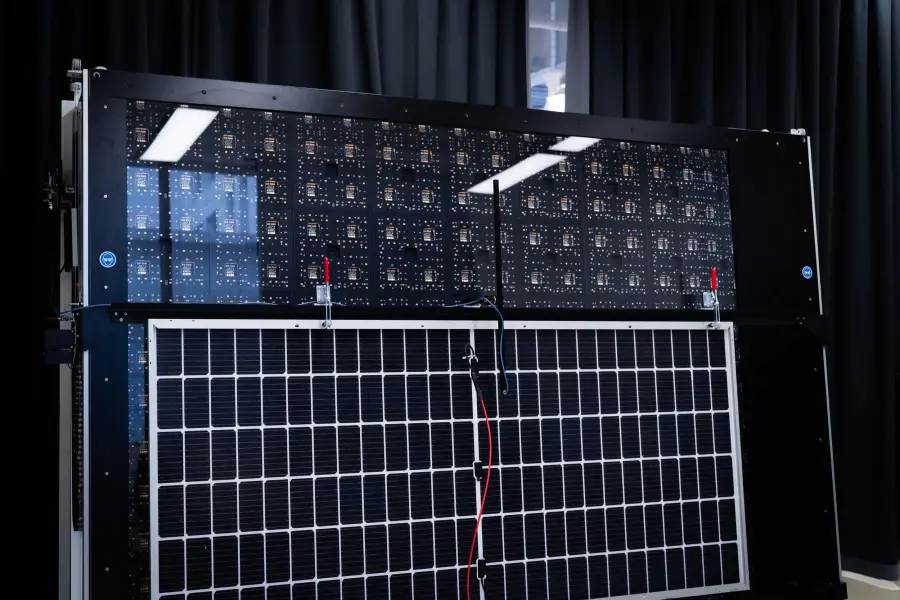
- Electroluminescence ImagingMulti-camera EL module for a defect image of every serial.
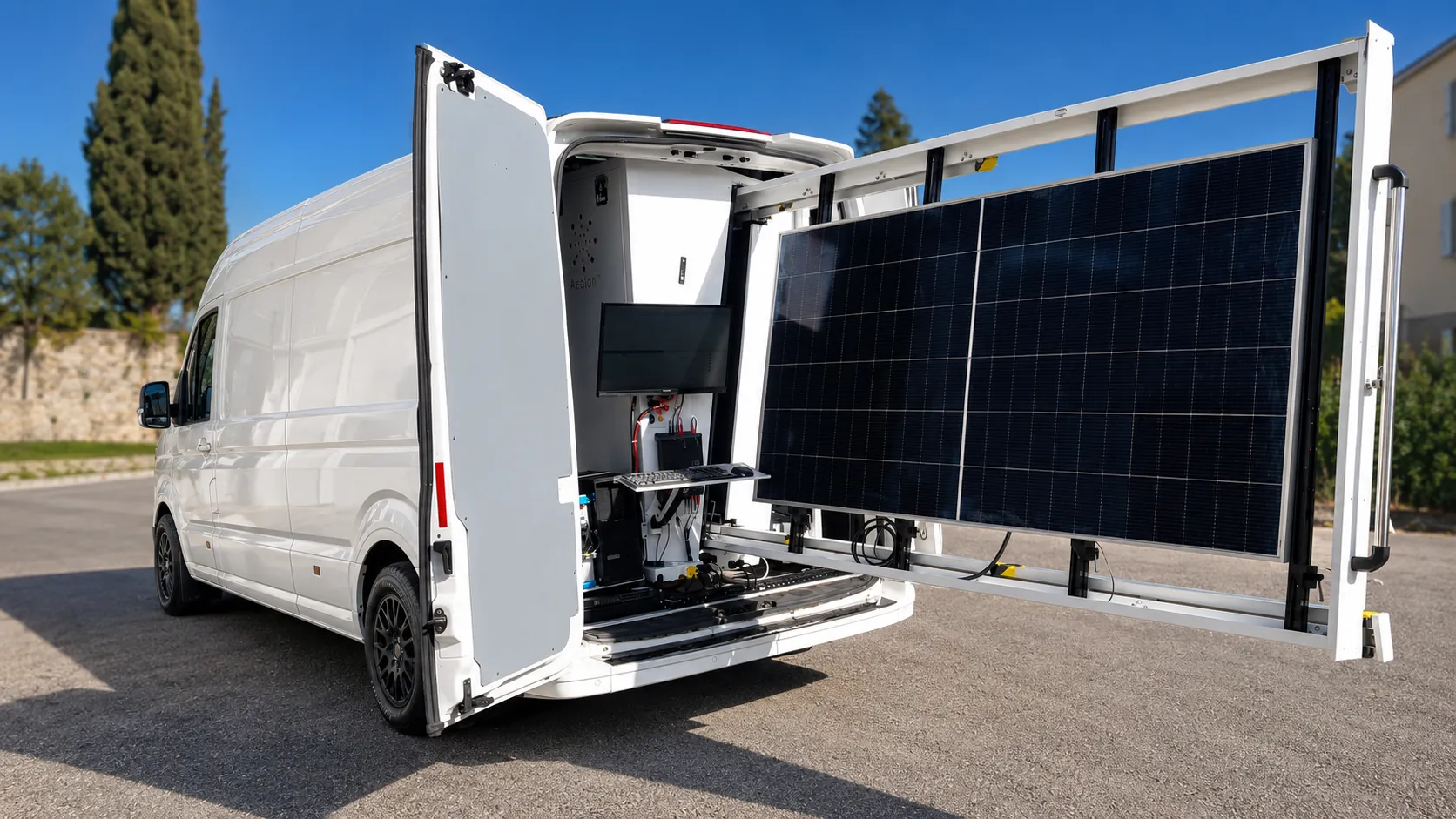
- Nexun LED simulators (Avalon ST)Full-LED production simulators of Pasan's sister company.
Technical questions
- Which document guides production flash testing?
- IEC TR 60904-14:2020 [1].
- How often should golden modules be recalibrated?
- The JRC guidelines recommend yearly traceability checks and overlapping pairs [2].
- How tight are label tolerances today?
- Commonly -0/+3 %, down from ±10 % in the 1980s and 1990s, according to JRC data on 992 modules [3].
- Can a production line rate HJT or TOPCon modules at line speed?
- Yes, with an acquisition shown equivalent to steady state: a long pulse, a validated shaped-voltage method, or multi-flash at the cost of cycle time [4].
References
- , “IEC TR 60904-14:2020, Guidelines for production line measurements of single-junction PV module maximum power output and reporting at standard test conditions”, International Electrotechnical Commission, 2020. Source
- , “Guidelines for PV power measurement in industry”, EUR 24359 EN, Publications Office of the European Union, 2010. Source
- , “Evolution of measured module characteristics versus labelled module characteristics of crystalline silicon based PV modules”, Solar Energy 160, 252-259, 2018. doi:10.1016/j.solener.2017.12.018
- , “The effect of capacitance on high-efficiency photovoltaic modules: a review of testing methods and related uncertainties”, Journal of Physics D: Applied Physics 54, 193001, 2021. doi:10.1088/1361-6463/abe574
- , “Fast and accurate methods for the performance testing of highly-efficient c-Si photovoltaic modules using a 10 ms single-pulse solar simulator and customized voltage profiles”, Measurement Science and Technology 23, 115604, 2012. doi:10.1088/0957-0233/23/11/115604
How this page is written: claims about physics and standards cite published sources, claims about Pasan equipment repeat only what the product pages state, and no other manufacturer is named. Editorial method