

 Electroluminescence Imaging
The measurement problem
Discussions of xenon versus LED, or pulse versus continuous light, often mix the time a measurement takes with the state the device is in. Three time scales matter: capacitive response of high-efficiency silicon (milliseconds to hundreds of milliseconds) [1], ionic response of perovskite (seconds to minutes) [3], and metastable states of thin film and some silicon effects (hours to days) [4][5].
The physics behind it
IEC 60904-9:2020 itself distinguishes steady-state, single-pulse and multi-pulse simulators, pulsed systems acquiring the whole curve or one sector per flash, and LED multi-lamp simulators as a distinct type [6]. IEC 60904-1:2020 asks for the measurement to be equivalent to steady-state performance, with an annex on capacitive devices.
What the measurement must achieve
- Show equivalence to steady state for the device type: forward and reverse sweeps, two acquisition times, or comparison with multi-flash or steady-state.
- Precondition separately when the device is metastable, with a documented dose, temperature and delay.
- Control temperature in proportion to exposure time: negligible heating for a flash, active control for steady state.
- Classify the simulator in the mode actually used (pulse, multi-pulse, steady state, light soaking) [6].
Applicable standards
| Standard | What it governs here |
|---|---|
| IEC 60904-1:2020Measurement of photovoltaic current-voltage characteristics | Stabilisation (4.3), equivalence to steady-state performance (4.4), capacitive devices (Annex B). |
| IEC 60904-9:2020 (edition 3)Classification of solar simulator characteristics | Simulator modes; STI per data point, LTI per I-V acquisition (or sum of sectors), LTI for long irradiation exposures. |
| IEC 61215-2:2021Terrestrial PV modules, design qualification and type approval: test procedures | MQT 19 stabilisation, the preconditioning in qualification. |
| IEC TR 63228:2019Measurement protocols for PV devices based on organic, dye-sensitized or perovskite materials | Transient behaviour of perovskite and other emerging devices. |
Measurement technologies: advantages and limitations
| Device | Short pulse (ms) | Long pulse (about 10 to 100+ ms) | Multi-flash | Steady state | Separate preconditioning? |
|---|---|---|---|---|---|
| Standard c-Si (PERC, Al-BSF) | Generally adequate; 2 to 10 ms typical [7] | Adequate | Adequate | Adequate (control heating) | LID / LeTID per qualification |
| HJT, IBC, large n-type | Errors over 20 % possible with fast sweeps [7] | Better; 100 ms may be insufficient [1]; shaped profiles within 0.5 % in 10 ms [8] | Reference method | Removes the artefact | Device dependent |
| TOPCon | Hysteresis reported [9] | Verify by sweep tests | Adequate | Adequate | Short light soak after UV or dark storage [10] |
| CdTe, CIGS, a-Si | Adequate for CdTe and CIGS (no effect above about 1 ms) [11]; a-Si sweep-sensitive | No specific benefit found | No specific benefit found | Can combine soak and measurement; temperature control critical [12] | Yes, essential |
| Perovskite, perovskite-silicon tandem | Not steady state [3] | Not steady state | Not steady state | Required for stabilised power [13] | Yes, plus spectral adjustment for tandems |
Advantages and limitations
- Short-pulse xenon: high throughput, negligible heating, mature spectral filtering; limited by device response time [7].
- Long-pulse xenon: extends the range of devices measurable in one flash and keeps the module cool, easing temperature control [14]; still finite, so validate per product.
- Multi-flash: quasi-steady state per point with modest heating; longer total time; flash-to-flash variation enters the long-term instability [6].
- Steady-state lamp: true steady state, can precondition; heats the device and the lamp spectrum ages.
- LED: pulsed or continuous, tunable spectrum (required for multi-junction adjustment), electronic irradiance setting; needs per-channel spectral calibration and thermal stabilisation [15]. A vendor-authored comparison found an LED simulator more stable and closer to AM1.5G than a xenon unit of the same rating [16]; no independent study ranks lamp technologies by total power uncertainty.
Where Pasan equipment fits
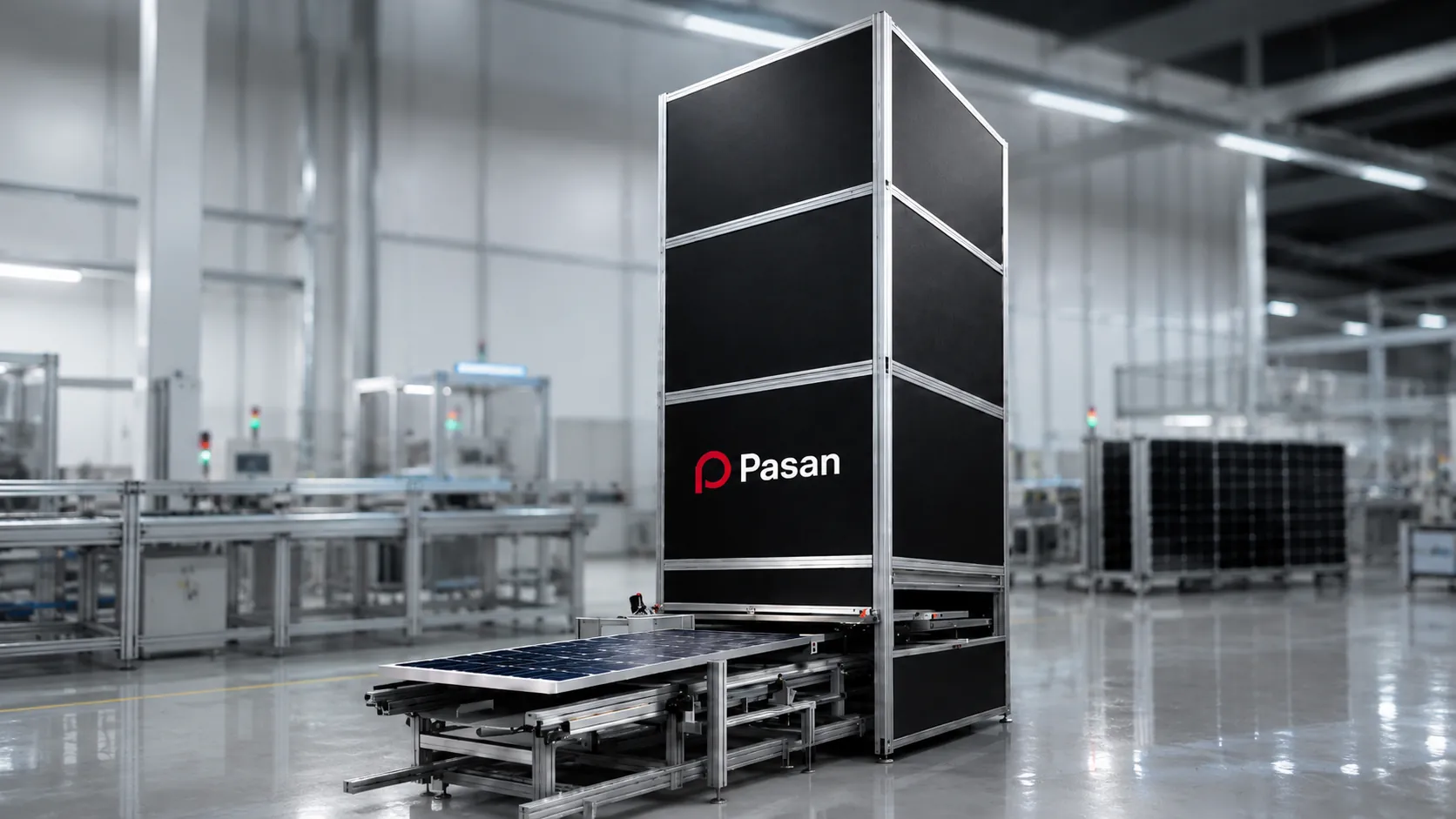
- HighLIGHT 100ms Lab and ProdLong-pulse xenon (40 to 100 ms plateau) with DragonBack® and SmartSweep for capacitive silicon.
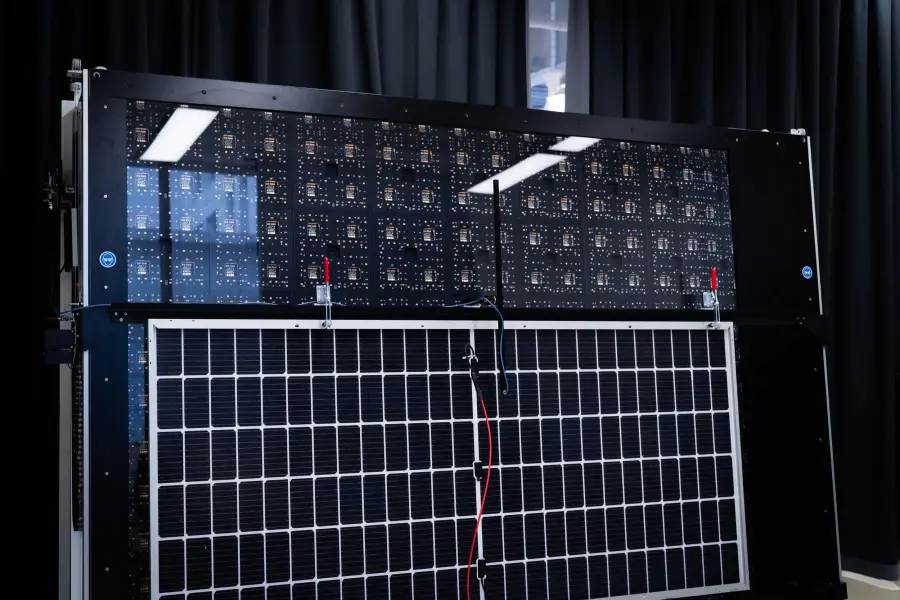
- LED Light SoakerContinuous LED light for preconditioning and steady-state I-V.
- Nexun LED simulators (Avalon ST)Full-LED pulsed and steady-state simulators of Pasan's sister company, including the Nexun Perovskite configuration.
Technical questions
- Does a long pulse replace light soaking?
- No. Pulse length addresses capacitive transients; preconditioning addresses metastable states that take hours [1][4].
- Is steady-state light more accurate than a pulse?
- Not in general. It is indispensable for perovskite stabilised power [13]; for CdTe, no evidence shows better I-V accuracy [11]; for capacitive silicon a validated long pulse reaches the same result.
- How do I prove a pulsed measurement is valid?
- Show equivalence to steady state, for example forward/reverse agreement or comparison with multi-flash, as IEC 60904-1:2020 requires.
- Is xenon or LED better?
- It depends on the device and the task: LED is required to adjust spectra per junction and convenient for long exposures; xenon pulses keep the module cool and have a smooth broadband spectrum. Uncertainty is dominated by the reference chain, mismatch, preconditioning and method rather than by lamp type.
References
- , “The effect of capacitance on high-efficiency photovoltaic modules: a review of testing methods and related uncertainties”, Journal of Physics D: Applied Physics 54, 193001, 2021. doi:10.1088/1361-6463/abe574
- , “Performance stabilization of CdTe PV modules using bias and light”, IEEE Journal of Photovoltaics 5(1), 344-349, 2015. doi:10.1109/JPHOTOV.2014.2370252
- , “How useful are conventional I-Vs for performance calibration of single- and two-junction perovskite solar cells?”, Solar RRL 6, 2100867, 2022. doi:10.1002/solr.202100867
- , “Metastable electrical characteristics of polycrystalline thin-film photovoltaic modules upon exposure and stabilization”, Journal of Photonics for Energy 2, 022001, 2012. doi:10.1117/1.JPE.2.022001
- , “UV-induced degradation and associated metastability in TOPCon photovoltaic modules: understanding kinetics and cell variance”, Progress in Photovoltaics 34, 589-599, 2026. doi:10.1002/pip.70067
- , “IEC 60904-9:2020, Photovoltaic devices, Part 9: Classification of solar simulator characteristics (edition 3.0)”, International Electrotechnical Commission, 2020. Source
- , “Guidelines for PV power measurement in industry”, EUR 24359 EN, Publications Office of the European Union, 2010. Source
- , “Fast and accurate methods for the performance testing of highly-efficient c-Si photovoltaic modules using a 10 ms single-pulse solar simulator and customized voltage profiles”, Measurement Science and Technology 23, 115604, 2012. doi:10.1088/0957-0233/23/11/115604
- , “Characterization and analysis of reverse breakdown voltage onset of solar cells with different cell architectures”, EPJ Photovoltaics 17, 4, 2026. doi:10.1051/epjpv/2025024
- , “UV-induced degradation: comparative analysis of PV module testing and stabilization procedures against outdoor behavior”, EPJ Photovoltaics 17, 15, 2026. doi:10.1051/epjpv/2026007
- , “Sweep time, spectral mismatch and light soaking in thin film module measurement”, 33rd IEEE Photovoltaic Specialists Conference, 2008. doi:10.1109/PVSC.2008.4922583
- , “Temperature-dependent light-stabilized states in thin-film PV modules”, 42nd IEEE Photovoltaic Specialists Conference, 2015. doi:10.1109/PVSC.2015.7355854
- , “Metastability in performance measurements of perovskite PV devices: a systematic approach”, Journal of Physics: Energy 3, 021001, 2021. doi:10.1088/2515-7655/abd678
- , “Accurate and rapid measurement of high-capacitance PV cells and modules using a single short pulse light”, 40th IEEE Photovoltaic Specialists Conference, 2014. doi:10.1109/PVSC.2014.6925295
- , “Traceable efficiency determination of large-area perovskite on silicon tandem modules: insights from a calibration laboratory's perspective”, Progress in Photovoltaics 33, 815-827, 2025. doi:10.1002/pip.3928
- , “Comparison of xenon lamp-based and LED-based solar simulators”, 43rd IEEE Photovoltaic Specialists Conference, 2016. doi:10.1109/PVSC.2016.7750227
How this page is written: claims about physics and standards cite published sources, claims about Pasan equipment repeat only what the product pages state, and no other manufacturer is named. Editorial method